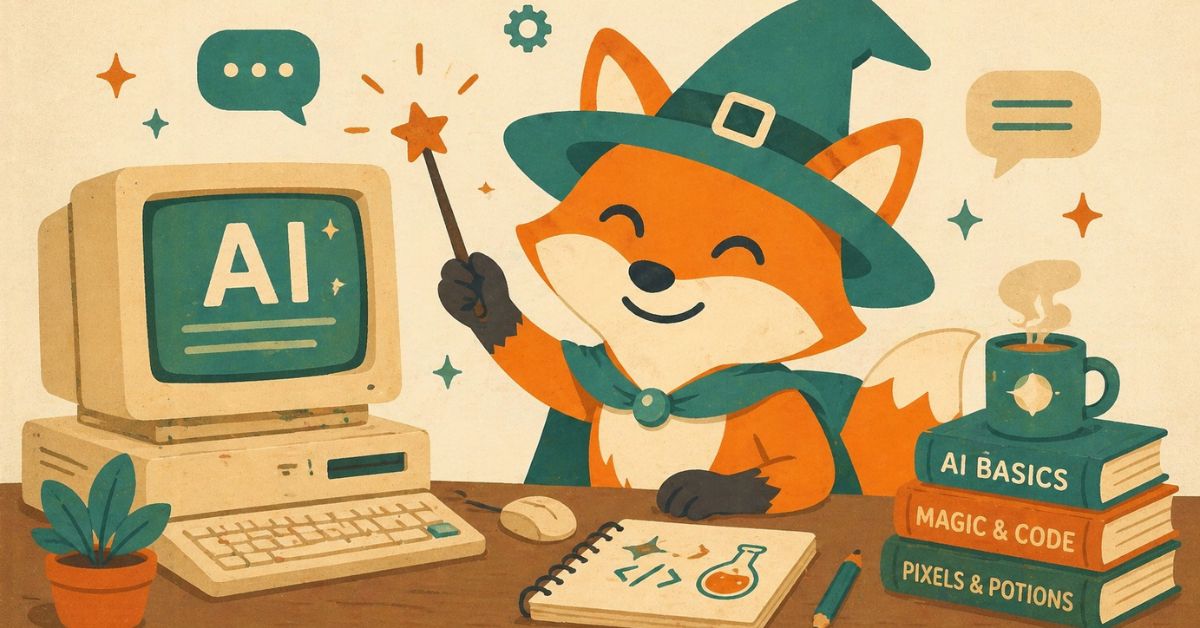
Confused about AI? This simple guide explains what artificial intelligence is, how it works, and what it can actually do in plain English.
Let me tell you a quick story
It’s 1956.
One Tuesday morning, a few researchers gathered on a campus in New Hampshire. Their plan came together over coffee – quietly at first, then louder as excitement grew
What if we could build a machine that thinks?
Not just a machine that follows instructions.
A machine that learns, reasons, and solves problems.
They called this idea Artificial Intelligence.
Back then, it sounded almost impossible.
Today, millions of people use it every day on their phones, at work, even at home.
And if you’re here wondering what AI really is…
You’re in the right place.
You might wonder what AI stands for?
AI stands for Artificial Intelligence.
Artificial = made by humans
Intelligence = the ability to learn and solve problems
Put together:
AI is something humans created that can learn and help solve tasks
That’s it.
So what IS AI in simple terms?
Let’s make this very easy.
AI is software that can do things that normally need human thinking.
For example:
- Answering questions
- Writing text
- Explaining ideas
- Giving suggestions
Picture this like a walk through the park on a quiet morning
AI is like a smart helper you can talk to
You ask something.
It gives you an answer.
A simple example you can relate to
Imagine a person who has spent years reading.
Every book. Every article. Every conversation.
Now imagine asking that person a question.
Because they’ve seen so much, they can usually give you a good answer.
That’s what AI is doing.
It hasn’t lived a life like you.
But it has learned from a huge amount of human knowledge.
You’ve probably already used AI
Most people don’t realise this.
You may already be using AI every day:
- Your phone suggesting words while typing
- Netflix recommending shows
- Google giving you answers
- Tools like ChatGPT responding to your questions
AI is already part of your daily life
How does AI actually work?
Let’s keep this simple.
Normal software follows strict rules.
Example:
- You press 2 + 2
- It gives you 4
AI is different.
Instead of rules, AI learns from examples.
Think about it like this
If you wanted to recognise a dog, you wouldn’t read a rule book.
You would look at many pictures.
Over time, you understand:
“This looks like a dog.”
AI learns the same way.
- It studies a lot of data
- It finds patterns
- It uses those patterns to respond
Another simple way to see it
Think about training a dog.
You show it something again and again.
Eventually, it learns.
AI learns in a similar way but using data
This is called machine learning
What are the different types of AI?
You don’t need to remember all of this. But here’s a simple version.
1. Reactive AI
It only responds to what is happening right now.
Example: spam filters, basic game AI
2. Limited Memory AI
It remembers things for a short time.
Example: ChatGPT, Netflix recommendations
3. Theory of Mind AI
This would understand human emotions.
This does not fully exist yet
4. Self-aware AI
This would be conscious like a human.
This is still science fiction
What is Generative AI?
You may hear the term Generative AI.
This simply means:
AI that can create things
For example:
- Writing text
- Creating images
- Making videos
Tools like ChatGPT fall into this category.
What is an AI agent?

A normal AI tool waits for you to ask something.
An AI agent can take action.
For example:
- Book something
- Send emails
- Complete tasks automatically
This is still new, but it’s growing fast.
What can AI do that humans cannot?
AI has some powerful advantages.
It can:
- Read huge amounts of information in seconds
- Work all day without getting tired
- Handle very complex data
- Talk to millions of people at the same time
You can’t do that.
But here’s the important part:
What AI cannot do
AI cannot:
- Feel emotions
- Have real experiences
- Make true personal decisions
- Understand life like you do
It is a tool not a human
Can AI think for itself?
This is a common question.
The answer is no
AI does not think the way you think.
It does not:
- Have thoughts
- Have feelings
- Have goals
It simply predicts the best response based on what it learned.
It may sound smart. but it’s still pattern based.
What can AI actually do for you?
This is where it becomes useful.
You can use AI to:
- Write emails quickly
- Understand confusing topics
- Get ideas when you are stuck
- Summarise long information
- Plan your day
If you can type a message…
You can use AI
Where is AI used?
AI is everywhere now.
You can find it in:
- Phones
- Apps
- Websites
- Online services
- Work tools
Most of the time, you don’t even notice it.
Can you use AI for free?
Yes.
Most AI tools offer free versions.
You can start with tools like:
- ChatGPT
- Google Gemini
- Microsoft Copilot
You don’t need to pay to begin.
What is the biggest problem with AI?
AI is helpful, but not perfect.
The biggest issue is simple:
AI can give wrong answers
Sometimes it:
- Makes things up
- Gives outdated information
- Sounds confident but is incorrect
So always:
- Read carefully
- Double-check important things
What jobs will AI not replace?
Many people worry about this.
AI will struggle to replace jobs that need:
- Human connection (teachers, nurses)
- Physical work (plumbers, builders)
- Real judgement (leaders, decision makers)
- Creativity based on real life experience
The biggest change is not AI replacing people.
It’s people using AI replacing people who don’t
Let’s bring it all together
Back in 1956, AI was just an idea.
Today, it’s a tool you can use right now.
It doesn’t think like a human.
It doesn’t feel like a human.
But it can do something powerful:
It can take a huge amount of human knowledge and make it available to you instantly
That’s what makes it useful.
What should you do next?
Don’t try to learn everything.
Start small.
Go to an AI tool and ask something simple:
- “Explain this to me”
- “Help me write this”
- “Give me ideas for this”
That’s how most people begin.
Quick recap
- AI = Artificial Intelligence
- It is software that can do human-like tasks
- It learns from data
- It cannot think or feel like a human
- It is already part of daily life
- You can use it for free
Final thought
You don’t need to understand everything about AI.
You just need to be curious enough to try it.
That’s where it starts.
Next step
Read next:

One Comment