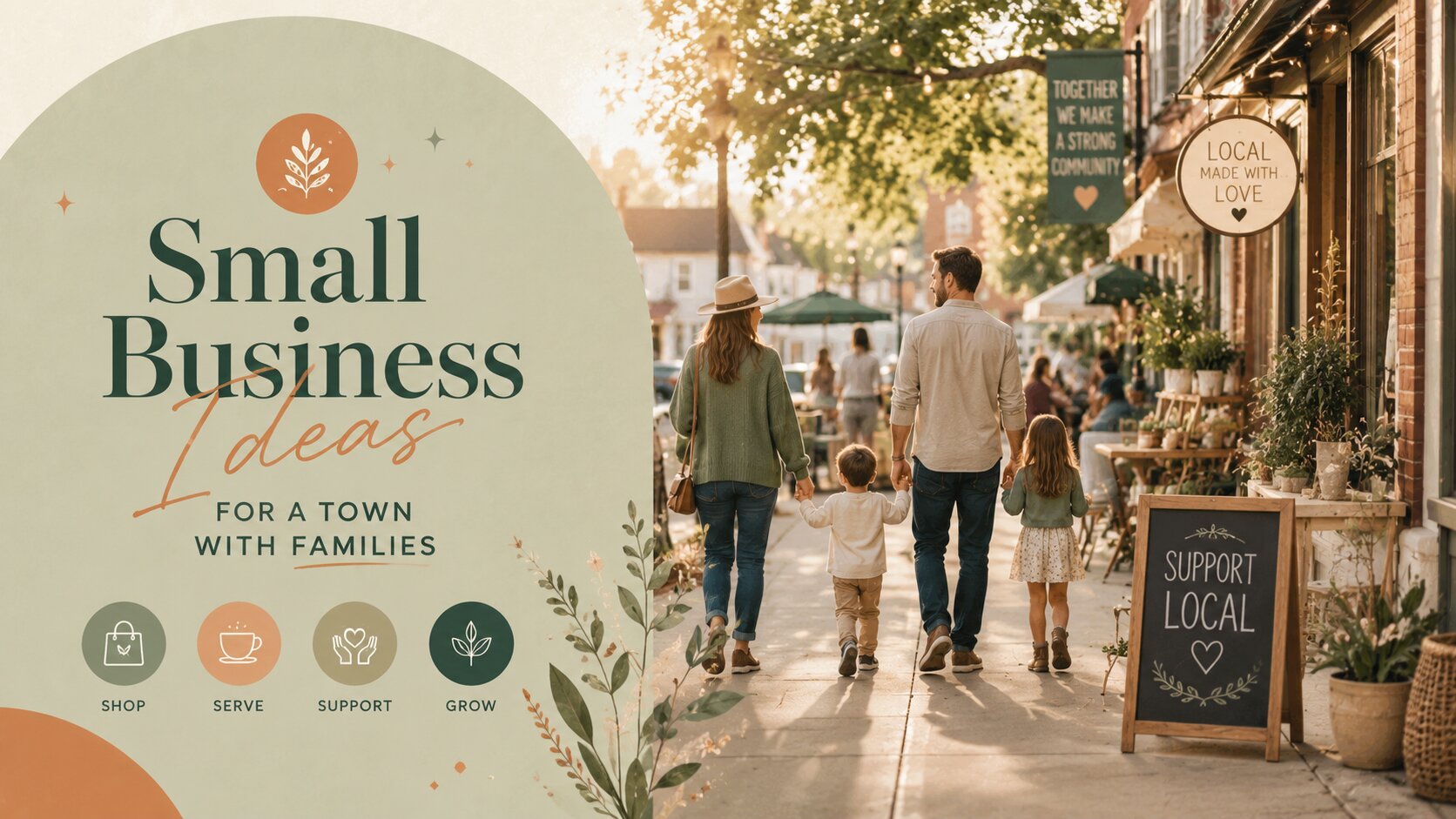
The best small business ideas for a town with families are businesses that solve everyday problems for parents and children, such as kids’ activity workshops, birthday party services, school holiday programs, soft play hire, family photography, mobile party setups, sensory play sessions, local convenience services, and creative classes. AI can help you compare these ideas, understand local demand, test pricing, and create simple marketing before you spend money.
Then continue with the emotional hook:
You look around your town and notice the same thing every weekend.
Parents are searching for something to do with the kids.
The playground is busy.
The local café is full of prams.
The indoor play centre is packed.
School holidays feel longer than they should.
Birthday party options are either expensive, fully booked, or just the same thing again and again.
And then the thought comes quietly:
Could I start a small business here?
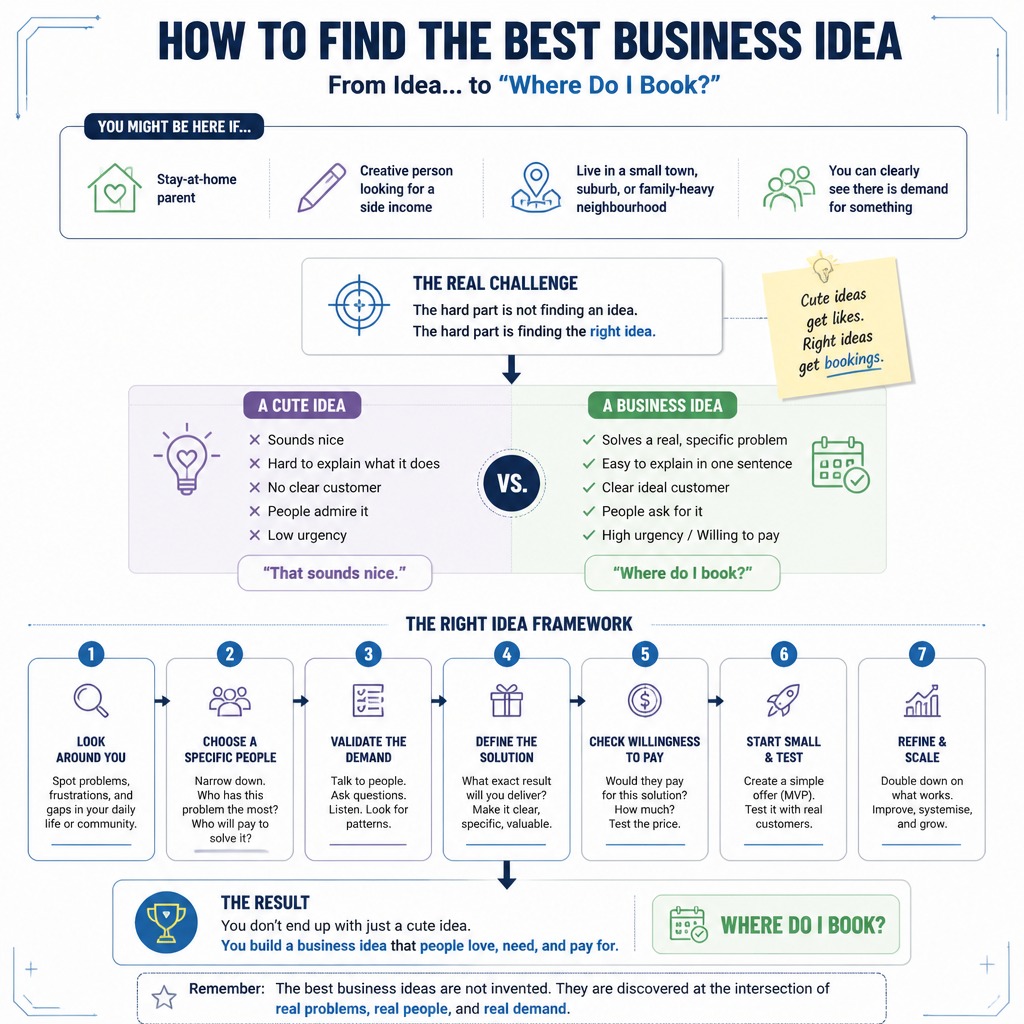
Maybe you are a stay-at-home parent.
Maybe you are a creative person looking for a side income.
Maybe you live in a small town, suburb, or family-heavy neighbourhood and you can clearly see there is demand for something.
But the hard part is not finding an idea.
The hard part is finding the right idea.
Because a cute idea is not the same as a business idea.
A cute idea makes people say, “That sounds nice.”
A business idea makes people say, “Where do I book?”
Why towns with families can be full of business opportunities
A family-friendly town has a special kind of rhythm.
Mornings are built around school drop-offs.
Afternoons are built around pickups, snacks, homework, sport, and tired parents.
Weekends are built around birthday parties, playgrounds, shopping, family lunches, kids’ activities, and the constant question:
In a Reddit discussion about small business ideas for a town with many stay-at-home mums and families, the original poster said their area already had indoor playgrounds, but families were still looking for activities and new things to do.
That is the interesting part.
When a town already has indoor playgrounds, cafés, schools, parks, and family spaces, it does not mean the market is finished.
It means families are already spending money on activities.
Your job is to find the gap.
Maybe parents want something calmer than an indoor playground.
Maybe they want creative activities, not just running and climbing.
Maybe they want weekend workshops.
Maybe they want affordable birthday party options.
Maybe they want school holiday programs.
Maybe they want something outdoors.
Maybe they want something that helps their kids learn, create, move, socialise, or burn energy.
This is why AI can be useful.
Not because AI magically knows your town.
It doesn’t.
But AI can help you organise your thoughts, compare ideas, create survey questions, write Facebook group posts, plan a test event, and turn a vague idea into something you can actually try.
Don’t start with the business idea. Start with the family problem.
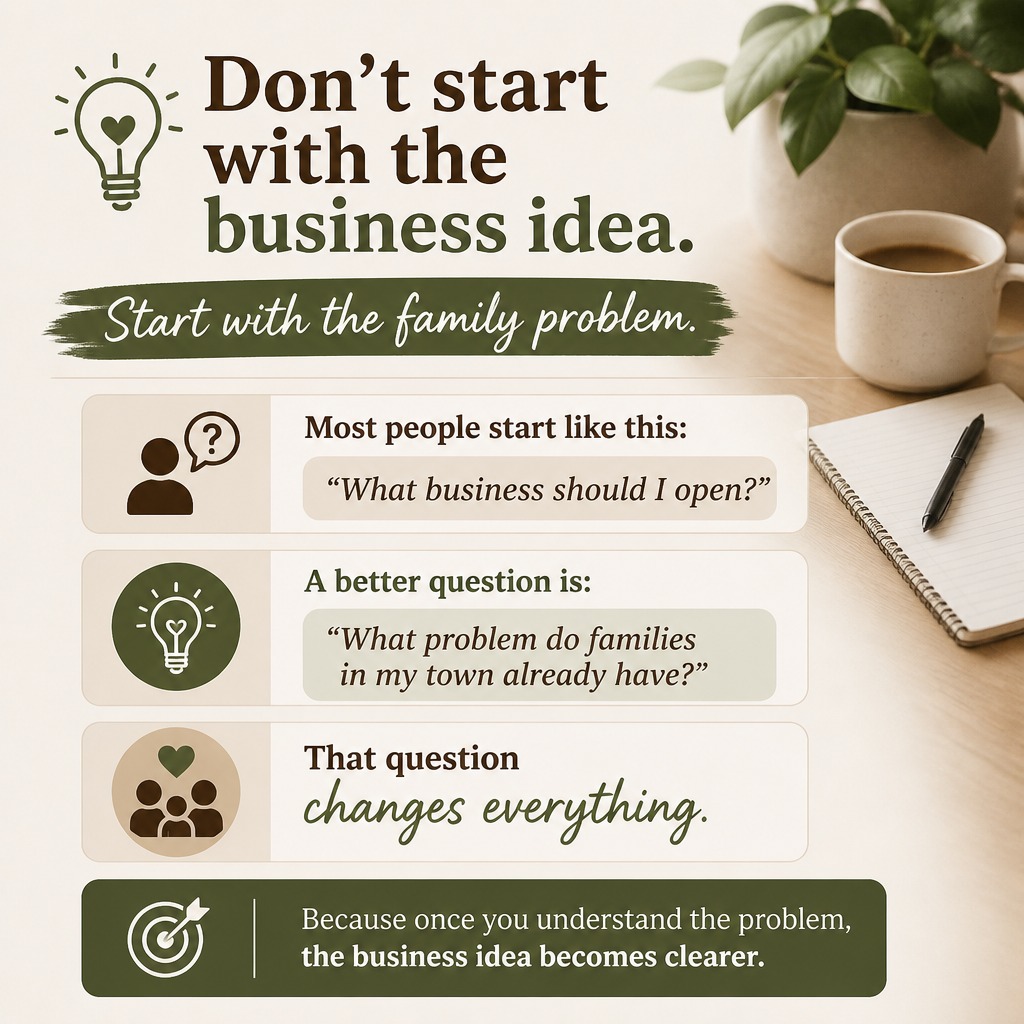
Most people start like this:
“What business should I open?”
A better question is:
That question changes everything.
Because once you understand the problem, the business idea becomes clearer.
For example:
| Family problem | Possible business idea |
| Parents need weekend activities | Kids craft workshops, outdoor play days, family events |
| Kids need birthday party options | Mobile party setup, themed party boxes, soft play hire |
| Parents need school holiday help | Art camps, cooking workshops, creative programs |
| Toddlers need safe play | Sensory play mornings, music sessions, toddler groups |
| Families want affordable outings | Picnic events, community markets, local activity trails |
| Parents want convenience | Lunchbox prep, kids labels, party planning, local delivery |
| Creative kids need more than screens | Art classes, pottery sessions, book clubs, gardening workshops |
This is the part many beginners skip.
They see one idea online and think, “That sounds good. I should do that.”
But your town might not need that idea.
Your town might need something smaller, simpler, cheaper, or more flexible.
A full indoor play centre might be too expensive.
But a Saturday morning kids craft pop-up at a local café?
That might be possible.
A permanent party venue might cost too much in rent.
But a mobile birthday party setup business?
That might be a much better starting point.
A full childcare centre might be complicated and heavily regulated.
But a children’s activity workshop, with proper planning, insurance, and safety checks?
That might be more realistic.
This is why your first goal is not to “start big.”
Your first goal is to find a small test version of the idea.
Use AI to brainstorm family-friendly business ideas
Here is a simple prompt you can copy and paste into ChatGPT, Claude, or your favourite AI tool:
AI Prompt:
I live in a small town with many families, stay-at-home parents, and school-age children. There are already some indoor playgrounds nearby. Help me brainstorm small business ideas that solve real family problems. Group the ideas into low-cost home-based ideas, weekend pop-up ideas, creative workshop ideas, birthday party ideas, and higher-investment ideas. For each idea, explain who would buy it, why they would need it, how often they might buy, startup cost level, risks, and one simple way to test demand before starting.
This prompt is useful because it does not just ask AI for ideas.
It asks AI to compare the ideas.
That is important.
A list of 50 ideas feels exciting for five minutes.
A comparison of 10 realistic ideas is much more useful.
When you use AI this way, you are not asking it to decide your future.
You are using it like a thinking partner.
It can help you see options you may not have considered.
But you still need to check the real world.
25 small business ideas for a town with families
Here are some family-friendly business ideas you could explore, especially if you live in a small town, suburb, or family-heavy neighbourhood.
1. Kids craft pop-up workshops
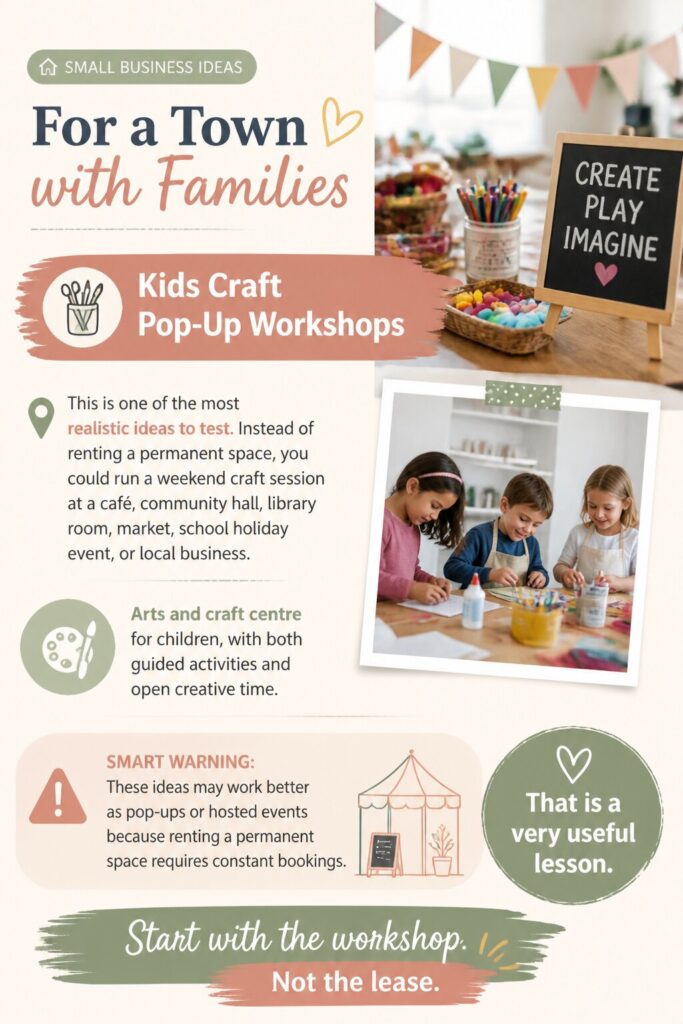
This is one of the most realistic ideas to test.
Instead of renting a permanent space, you could run a weekend craft session at a café, community hall, library room, market, school holiday event, or local business.
A Reddit commenter suggested an arts and craft centre for children, with both guided activities and open creative time. Another commenter added a smart warning: these ideas may work better as pop-ups or hosted events because renting a permanent space requires constant bookings.
That is a very useful lesson.
Start with the workshop.
Not the lease.
2. Mobile birthday party setup
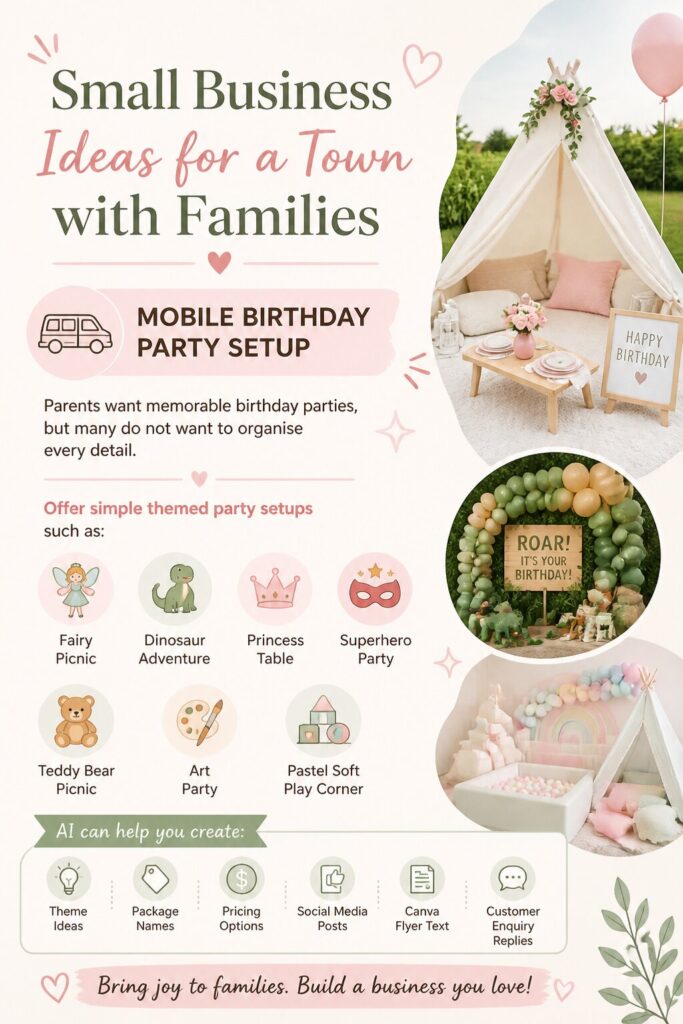
Parents want memorable birthday parties, but many do not want to organise every detail.
You could offer simple themed party setups such as fairy picnic, dinosaur adventure, princess table, superhero party, teddy bear picnic, art party, or pastel soft play corner.
AI can help you create:
- theme ideas
- package names
- pricing options
- social media posts
- Canva flyer text
- customer enquiry replies
3. Soft play equipment hire
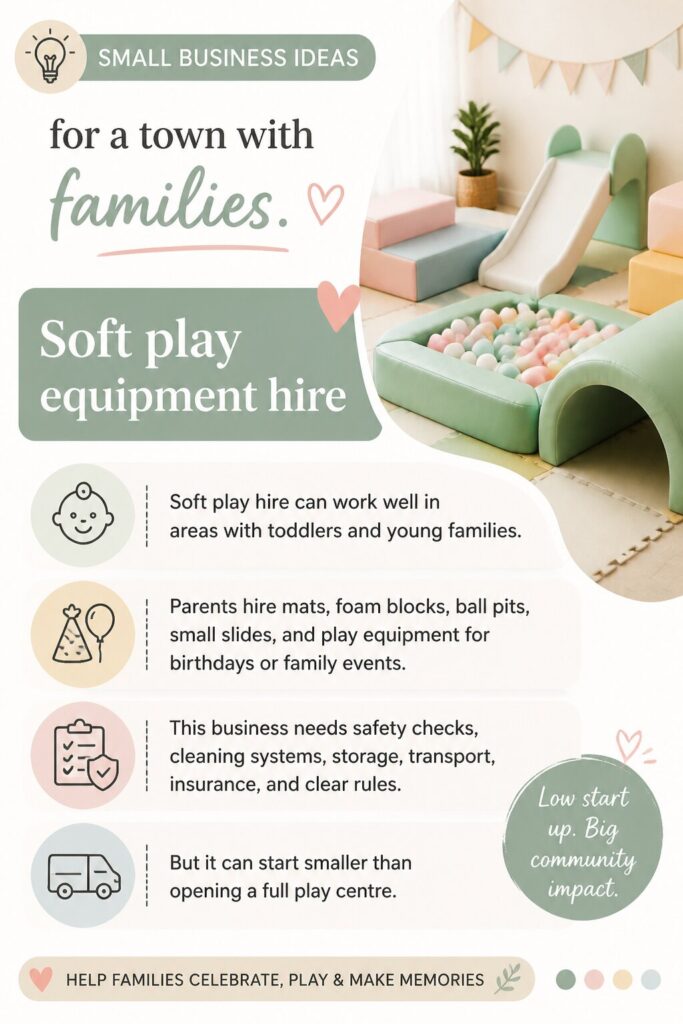
Soft play hire can work well in areas with toddlers and young families.
Parents hire mats, foam blocks, ball pits, small slides, and play equipment for birthdays or family events.
This business needs safety checks, cleaning systems, storage, transport, insurance, and clear rules.
But it can start smaller than opening a full play centre.
4. Sensory play mornings
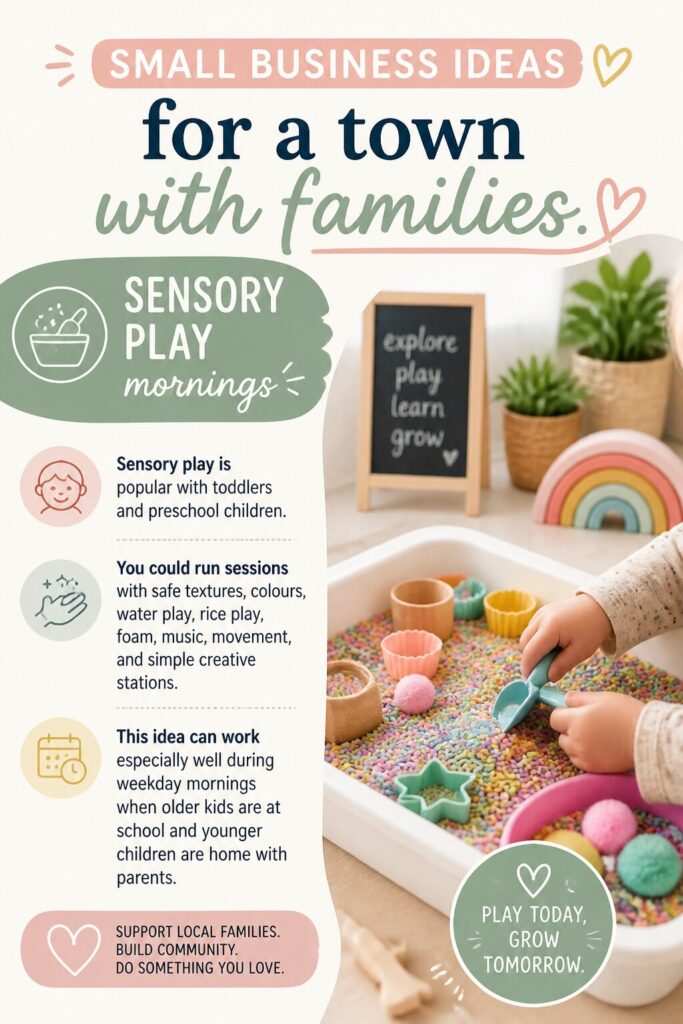
Sensory play is popular with toddlers and preschool children.
You could run sessions with safe textures, colours, water play, rice play, foam, music, movement, and simple creative stations.
This idea can work especially well during weekday mornings when older kids are at school and younger children are home with parents.
5. School holiday art camps
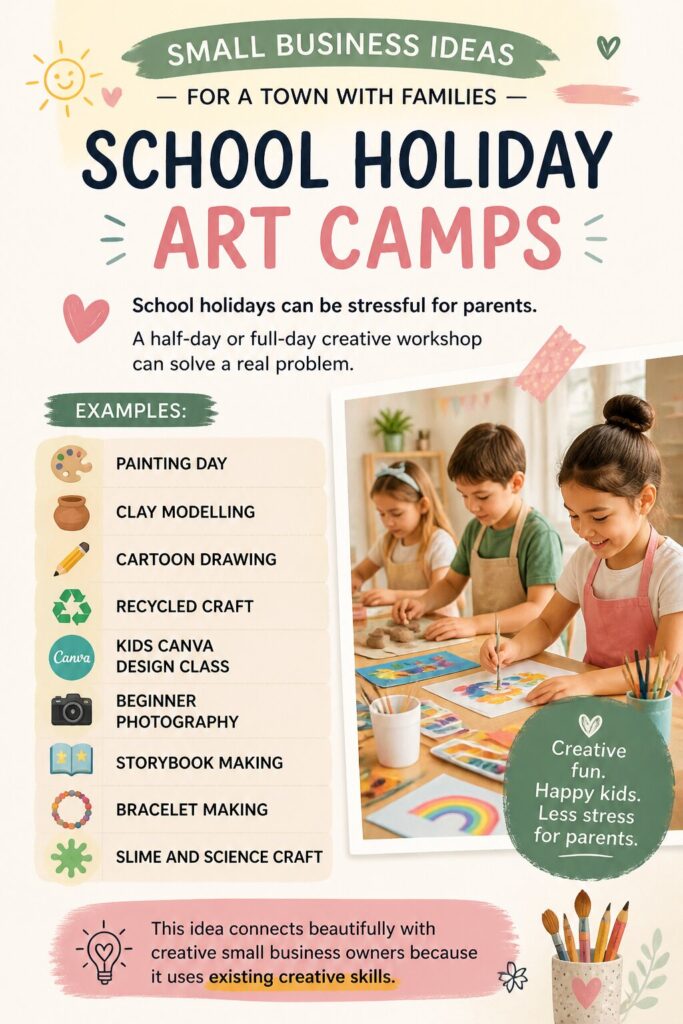
School holidays can be stressful for parents.
A half-day or full-day creative workshop can solve a real problem.
Examples:
- painting day
- clay modelling
- cartoon drawing
- recycled craft
- kids Canva design class
- beginner photography
- storybook making
- bracelet making
- slime and science craft
This idea connects beautifully with creative small business owners because it uses existing creative skills.
6. Family picnic styling
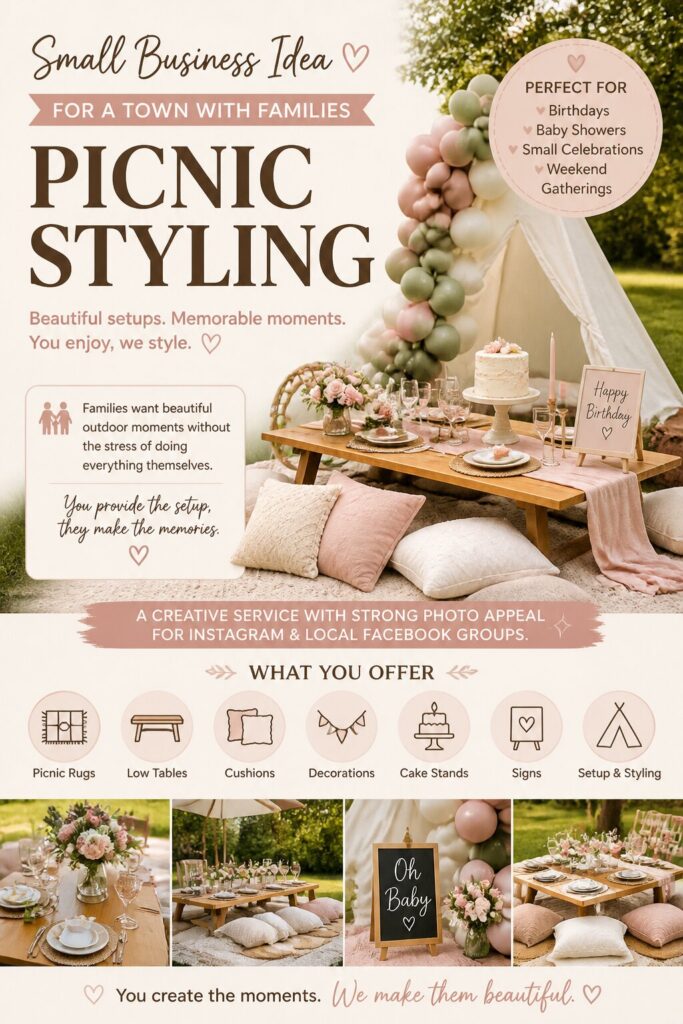
Some families want beautiful outdoor birthdays, baby showers, small celebrations, or weekend gatherings without doing all the styling themselves.
You could offer picnic rugs, low tables, cushions, decorations, cake stands, signs, and setup.
This can be a creative service with strong photo appeal for Instagram and local Facebook groups.
7. Outdoor adventure trail experience
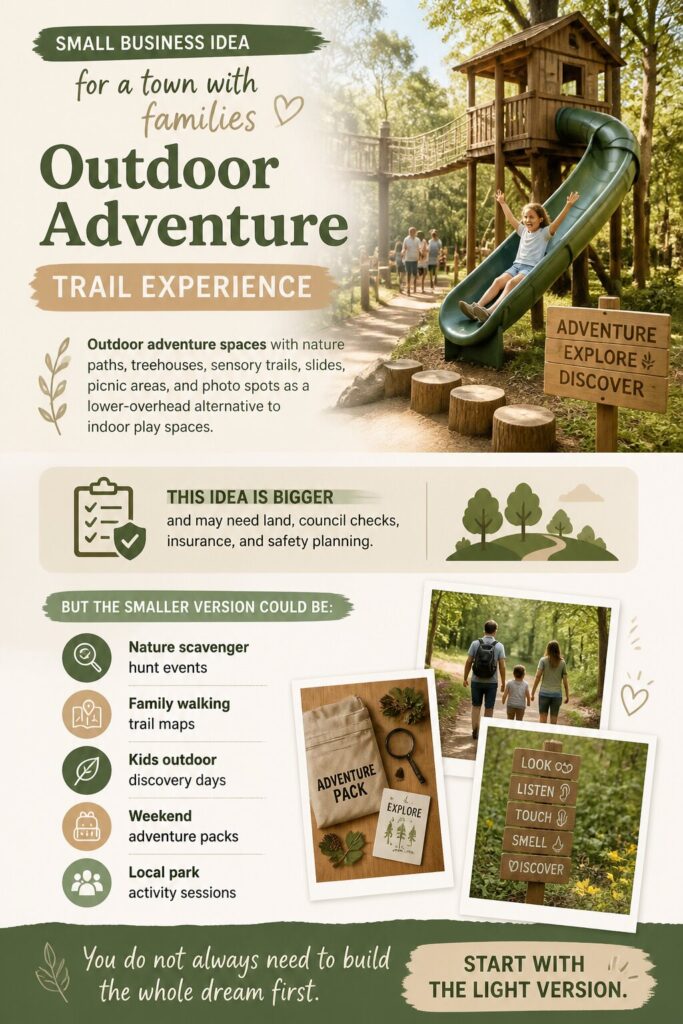
One Reddit commenter suggested outdoor adventure spaces with nature paths, treehouses, sensory trails, slides, picnic areas, and photo spots as a lower-overhead alternative to indoor play spaces.
This idea is bigger and may need land, council checks, insurance, and safety planning.
But the smaller version could be:
- nature scavenger hunt events
- family walking trail maps
- kids outdoor discovery days
- weekend adventure packs
- local park activity sessions
You do not always need to build the whole dream first.
Start with the light version.
8. Kids cooking workshops
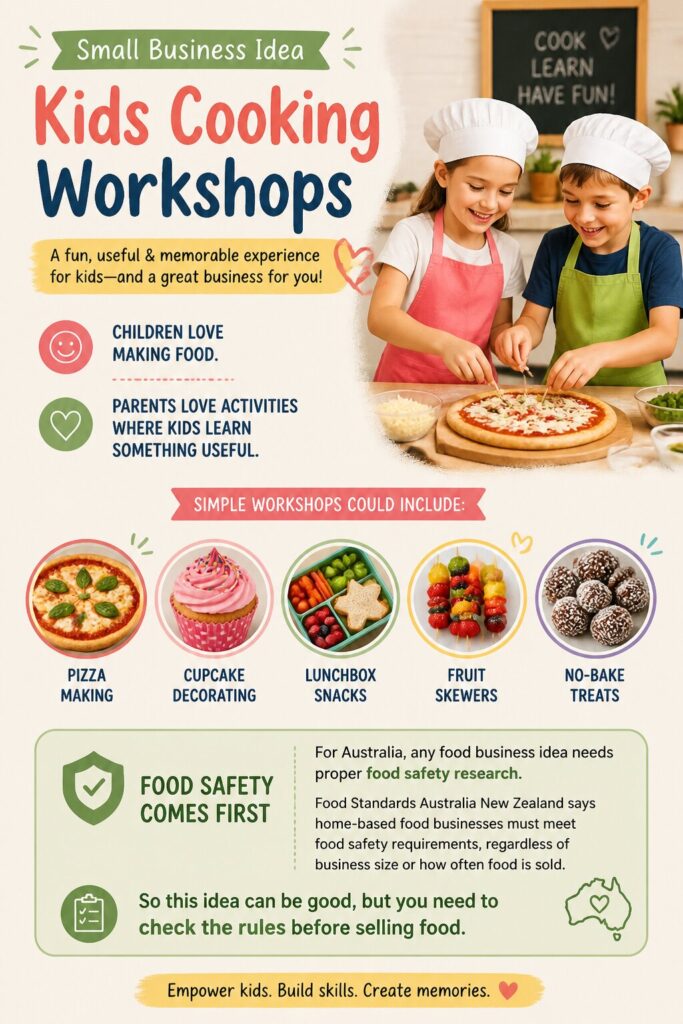
Children love making food.
Parents love activities where kids learn something useful.
Simple workshops could include pizza making, cupcake decorating, lunchbox snacks, fruit skewers, or no-bake treats.
For Australia, any food business idea needs proper food safety research. Food Standards Australia New Zealand says home-based food businesses must meet food safety requirements, regardless of business size or how often food is sold. (Food Standards Australia New Zealand)
So this idea can be good, but you need to check the rules before selling food.
9. Bubble tea or treat cart
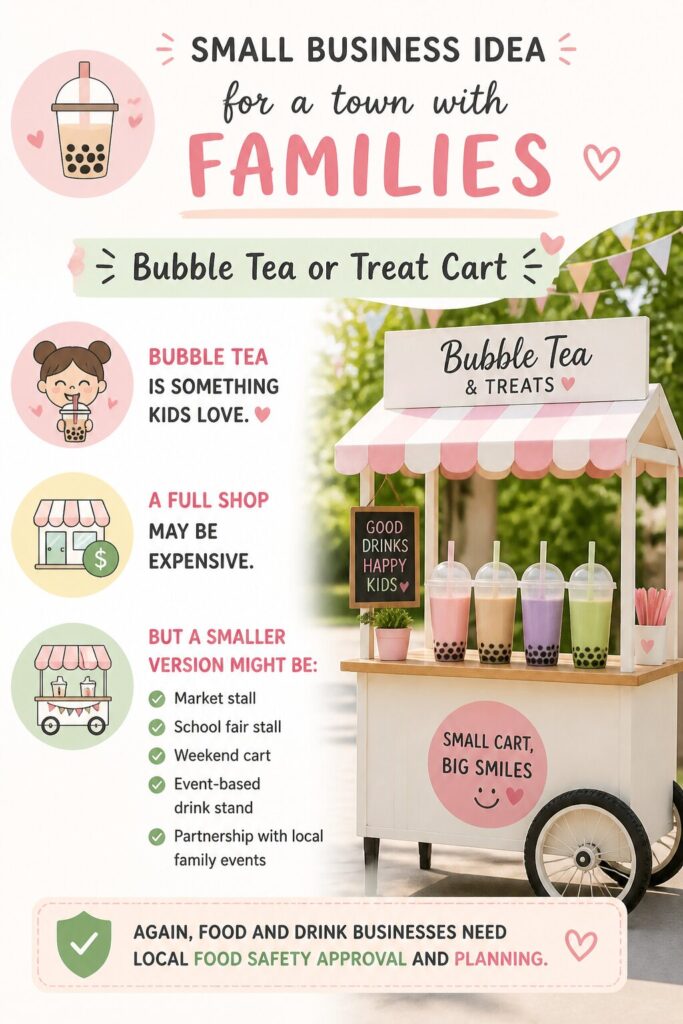
In the Reddit thread, one parent mentioned bubble tea as something kids in their area love.
A full shop may be expensive.
But a smaller version might be a market stall, school fair stall, weekend cart, event-based drink stand, or partnership with local family events.
Again, food and drink businesses need local food safety approval and planning.
10. Family mini photography sessions
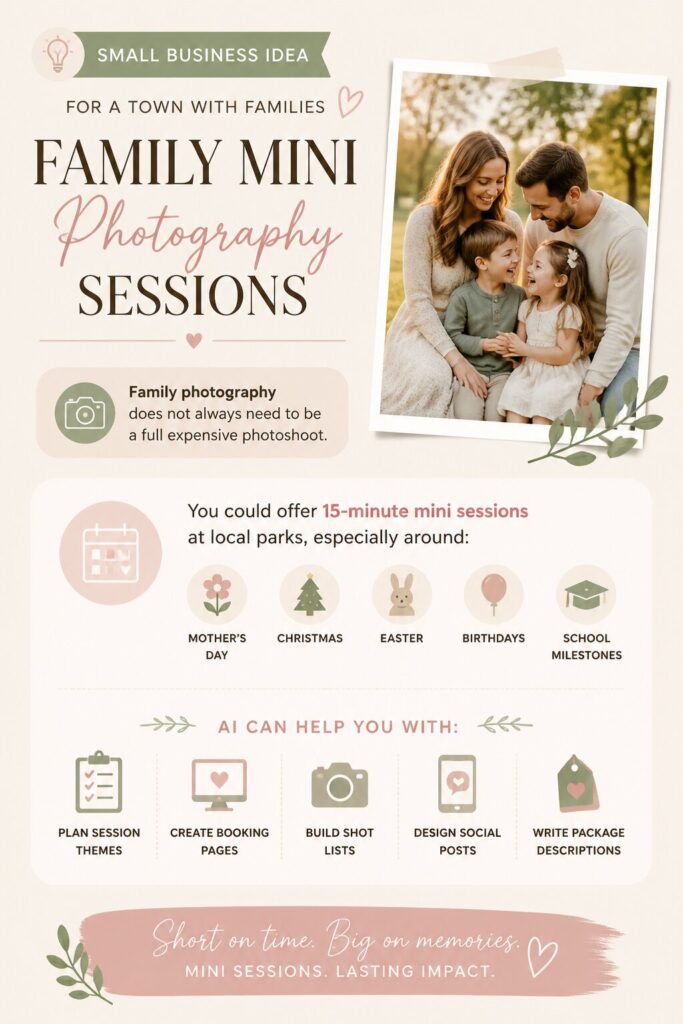
Family photography does not always need to be a full expensive photoshoot.
You could offer 15-minute mini sessions at local parks, especially around Mother’s Day, Christmas, Easter, birthdays, or school milestones.
AI can help you plan session themes, booking pages, shot lists, social posts, and package descriptions.
11. Kids gardening workshops
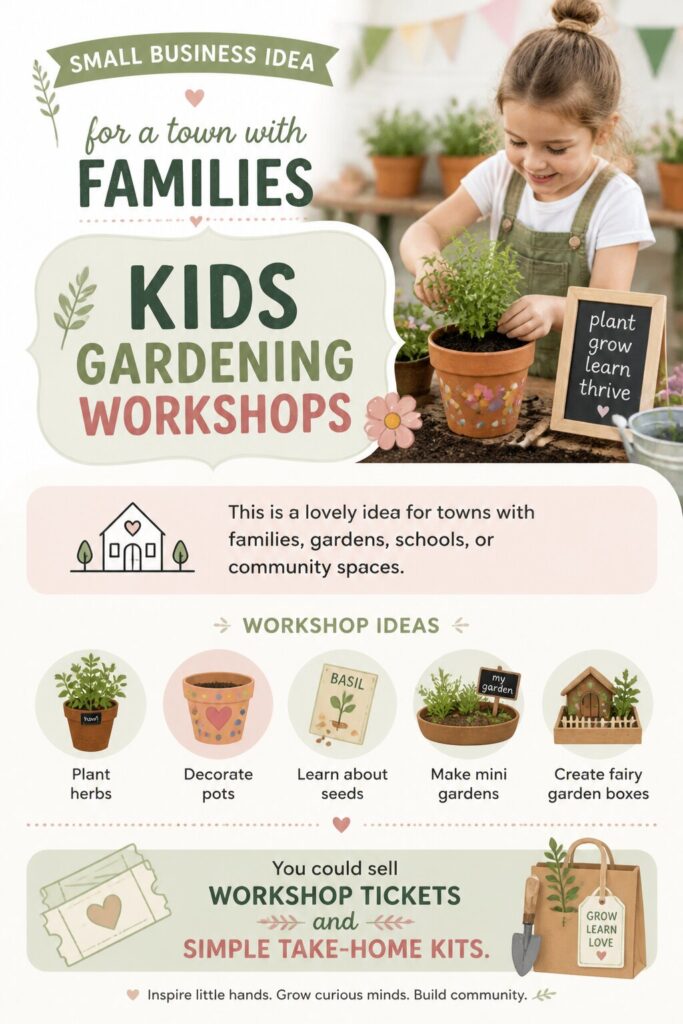
This is a lovely idea for towns with families, gardens, schools, or community spaces.
Children can plant herbs, decorate pots, learn about seeds, make mini gardens, or create fairy garden boxes.
You could sell workshop tickets and simple take-home kits.
12. Toy rotation or toy rental service
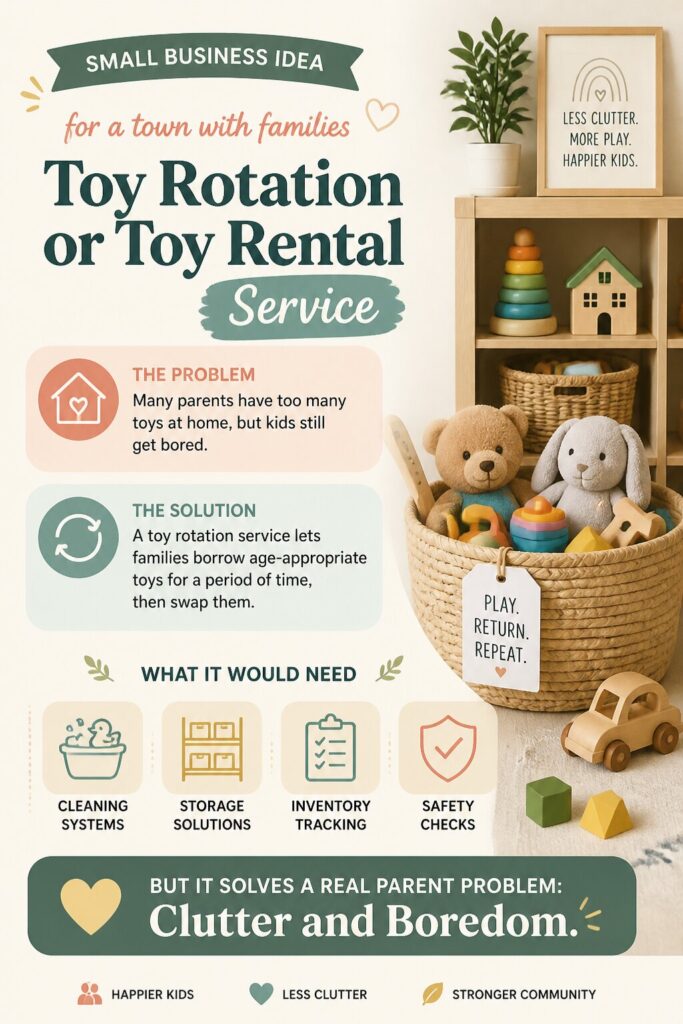
Many parents have too many toys at home, but kids still get bored.
A toy rotation service lets families borrow age-appropriate toys for a period of time, then swap them.
This would need cleaning systems, storage, inventory tracking, and safety checks.
But it solves a real parent problem: clutter and boredom.
13. Party box rental business
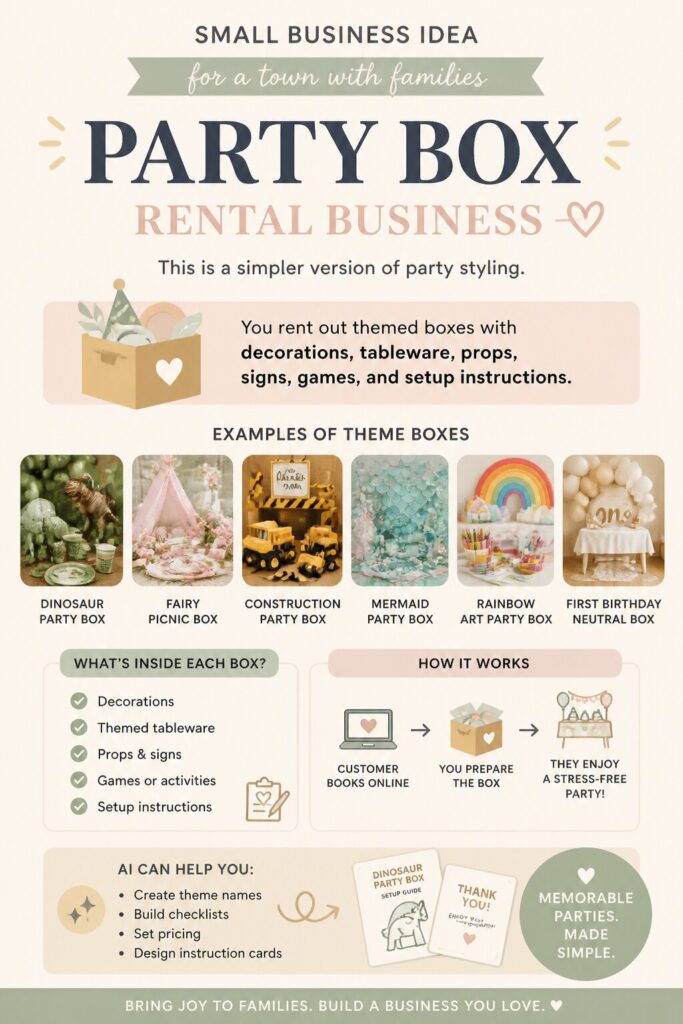
This is a simpler version of party styling.
You rent out themed boxes with decorations, tableware, props, signs, games, and setup instructions.
Examples:
- dinosaur party box
- fairy picnic box
- construction party box
- mermaid party box
- rainbow art party box
- first birthday neutral theme box
AI can help you create theme names, checklists, pricing, and instruction cards.
14. After-school creative club
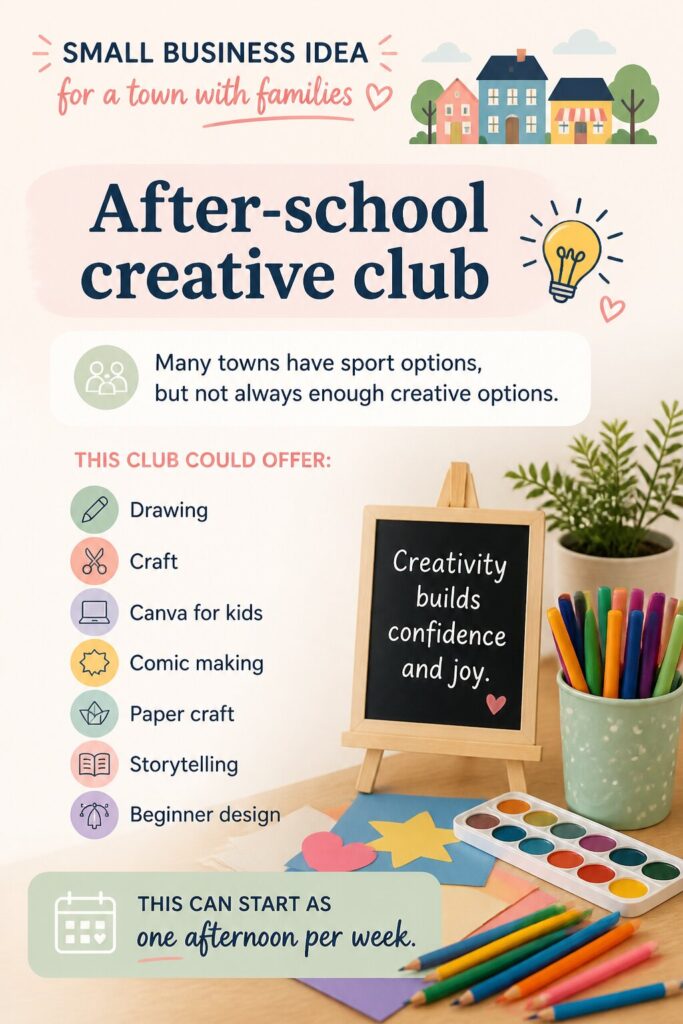
Many towns have sport options, but not always enough creative options.
An after-school creative club could offer drawing, craft, Canva for kids, comic making, paper craft, storytelling, or beginner design.
This can start as one afternoon per week.
15. Local kids activity directory
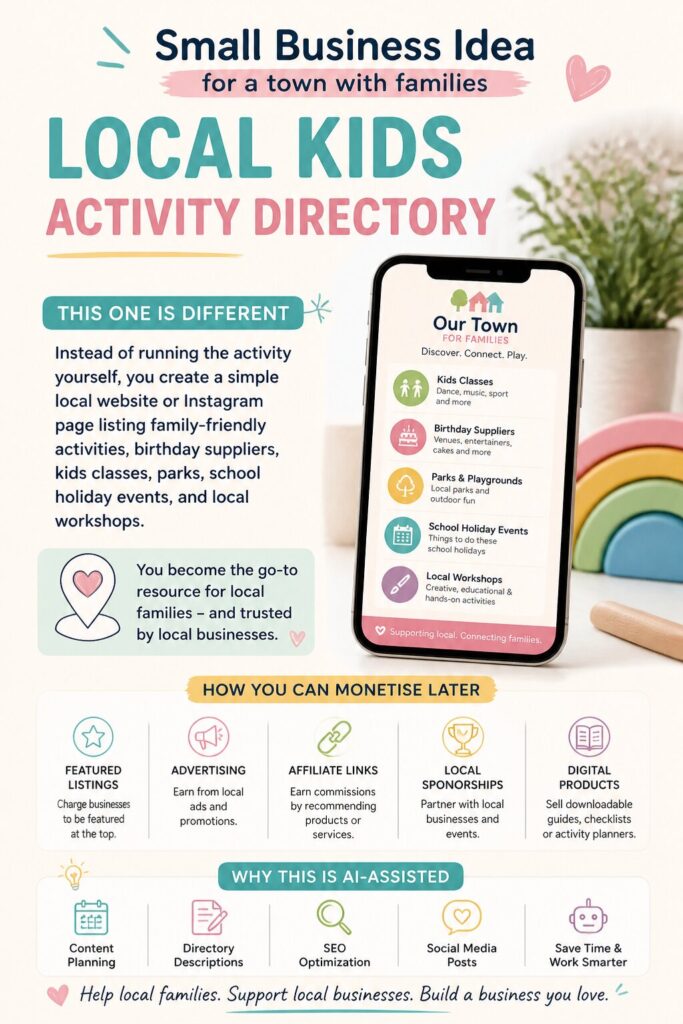
This one is different.
Instead of running the activity yourself, you create a simple local website or Instagram page listing family-friendly activities, birthday suppliers, kids classes, parks, school holiday events, and local workshops.
You could monetise later through featured listings, ads, affiliate links, local sponsorships, or downloadable guides.
This is a great AI-assisted idea because AI can help with content planning, directory descriptions, SEO, and social media posts.
16. AI flyer and social media service for local family businesses
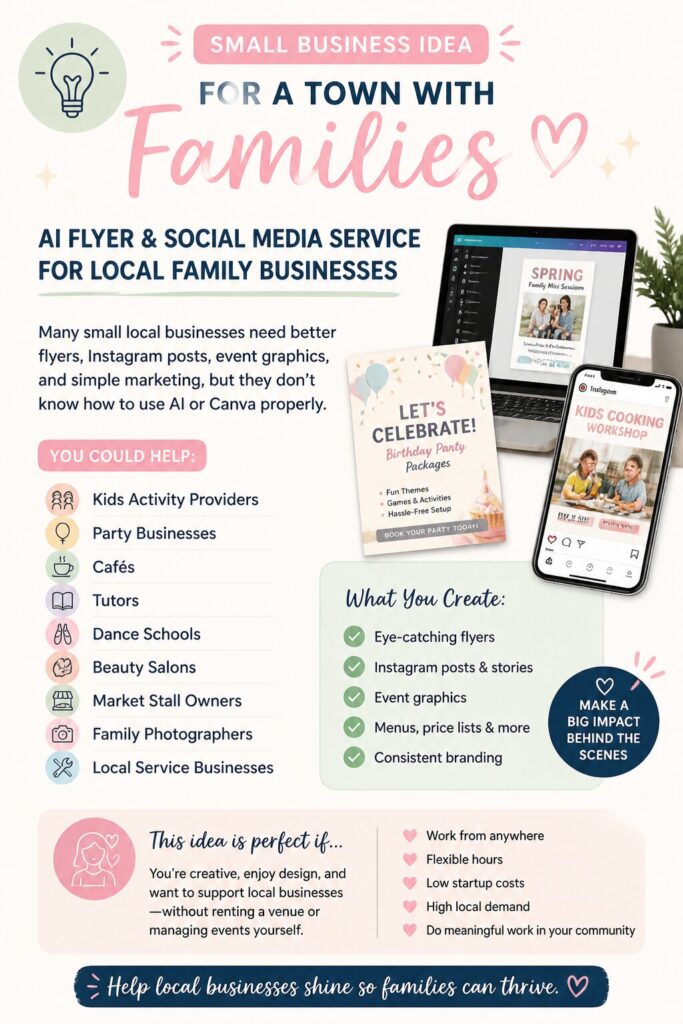
This idea is especially interesting if you are creative.
Many small local businesses need better flyers, Instagram posts, event graphics, and simple marketing, but they do not know how to use AI or Canva properly.
You could help:
- kids activity providers
- party businesses
- cafés
- tutors
- dance schools
- beauty salons
- market stall owners
- family photographers
- local service businesses
This idea fits people who are creative but do not want to rent a venue or manage children’s events directly.
17. Kid’s party entertainment service
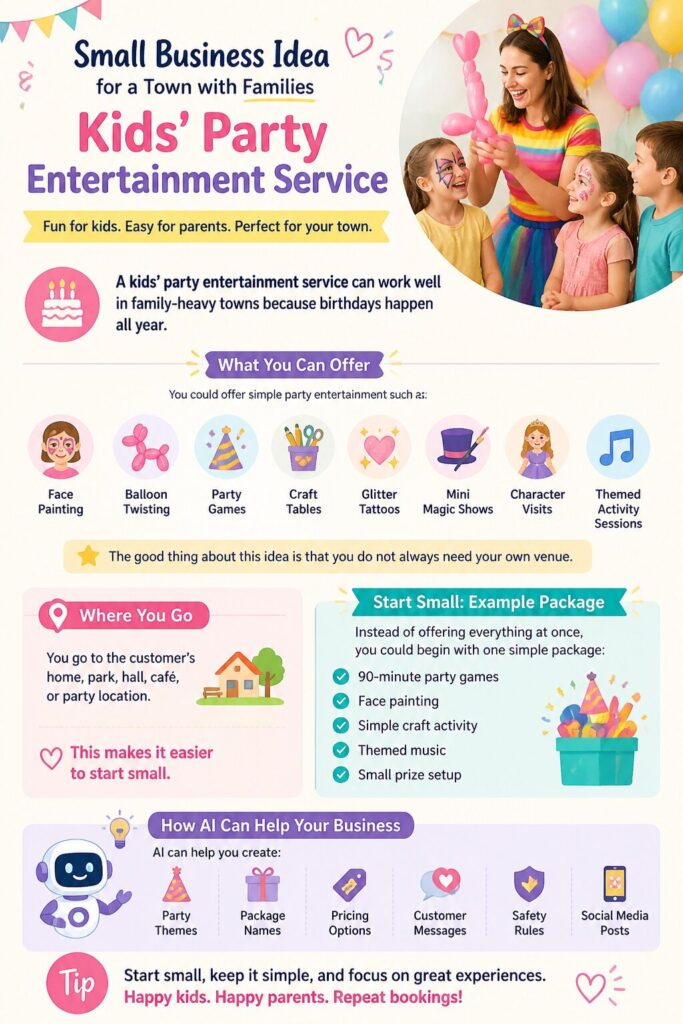
A kids’ party entertainment service can work well in family-heavy towns because birthdays happen all year.
You could offer simple party entertainment such as face painting, balloon twisting, party games, craft tables, glitter tattoos, character visits, mini magic shows, or themed activity sessions.
The good thing about this idea is that you do not always need your own venue.
You go to the customer’s home, park, hall, café, or party location.
This makes it easier to start small.
For example, instead of offering everything at once, you could begin with one simple package:
- 90-minute party games
- face painting
- simple craft activity
- themed music
- small prize setup
AI can help you create party themes, package names, pricing options, customer messages, safety rules, and social media posts.
This idea works best if you are confident with children, organised, energetic, and comfortable performing or guiding activities in front of families.
18. Family-friendly market stall
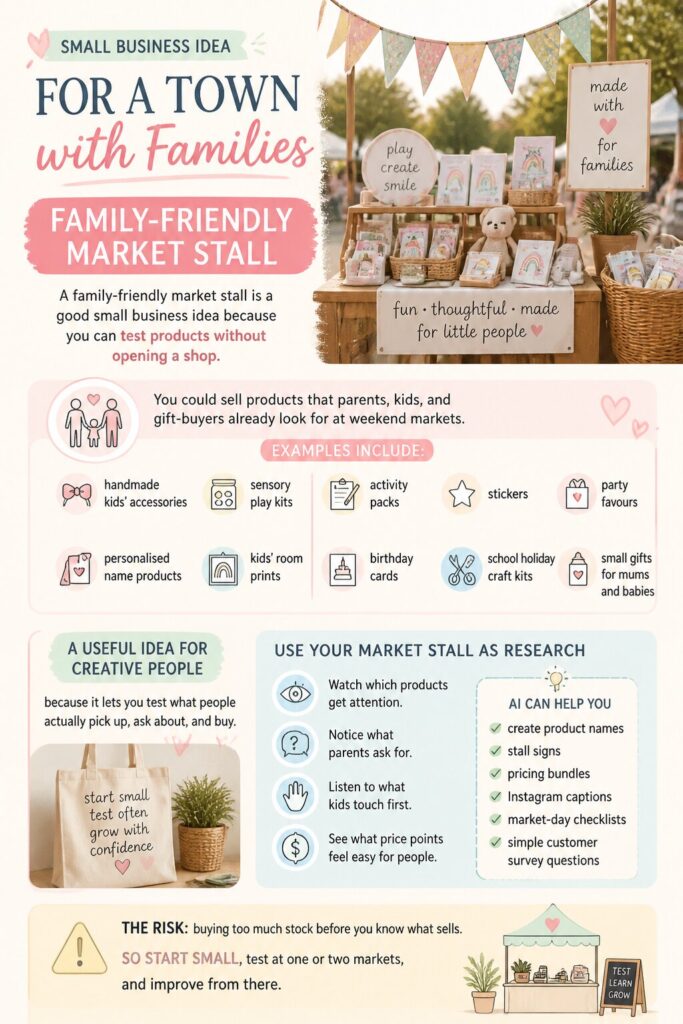
A family-friendly market stall is a good small business idea because you can test products without opening a shop.
You could sell products that parents, kids, and gift-buyers already look for at weekend markets.
Examples include:
- handmade kids’ accessories
- sensory play kits
- activity packs
- stickers
- party favours
- personalised name products
- kids’ room prints
- birthday cards
- school holiday craft kits
- small gifts for mums and babies
This is a useful idea for creative people because it lets you test what people actually pick up, ask about, and buy.
You can also use the market stall as research.
Watch which products get attention.
Notice what parents ask for.
Listen to what kids touch first.
See what price points feel easy for people.
AI can help you create product names, stall signs, pricing bundles, Instagram captions, market-day checklists, and simple customer survey questions.
The risk is buying too much stock before you know what sells.
So start with a small product range, test at one or two markets, and improve from there.
19. School lunchbox prep service
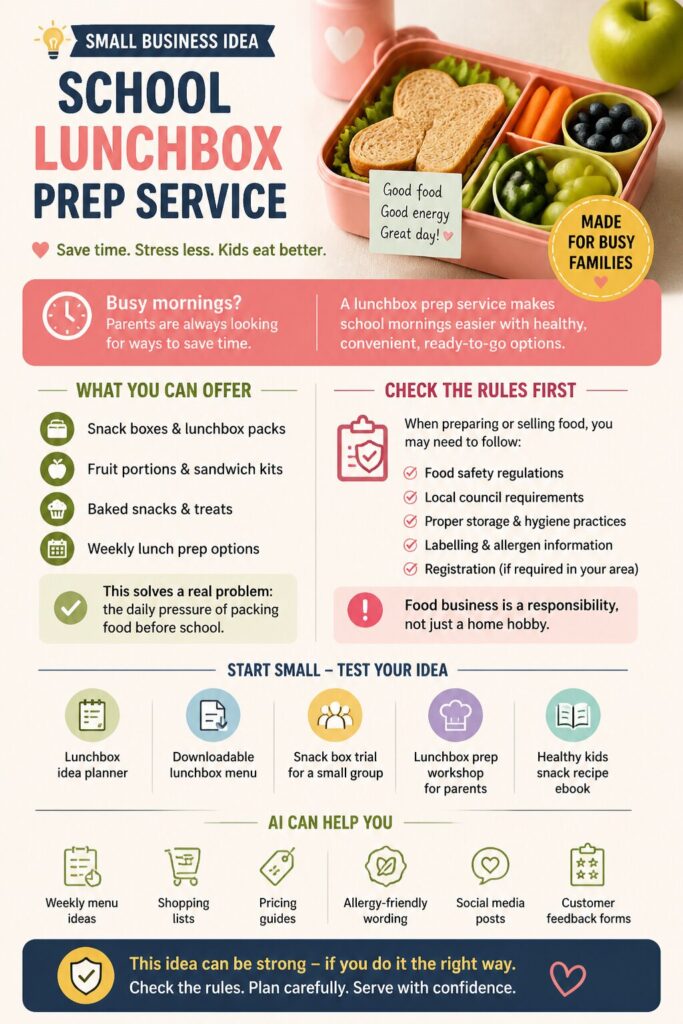
Busy parents are always looking for ways to save time in the morning.
A school lunchbox prep service could offer simple snack boxes, lunchbox packs, fruit portions, sandwich kits, baked snacks, or weekly lunch prep options.
This idea solves a real family problem: the daily pressure of packing food before school.
But this is also one of the ideas that needs proper checking before you start.
Because you are preparing or selling food, you may need to follow food safety rules, local council requirements, proper storage, labelling, hygiene practices, and possibly registration depending on your area.
A smaller test version could be:
- lunchbox idea planner
- downloadable lunchbox menu
- snack box trial for a small group
- lunchbox prep workshop for parents
- healthy kids snack recipe ebook
AI can help you create weekly menu ideas, shopping lists, pricing, allergy-friendly wording, social posts, and customer feedback forms.
This idea can be strong, but do not treat it like a casual home hobby. With food, you need to check the rules first.
20. Children’s book and activity club
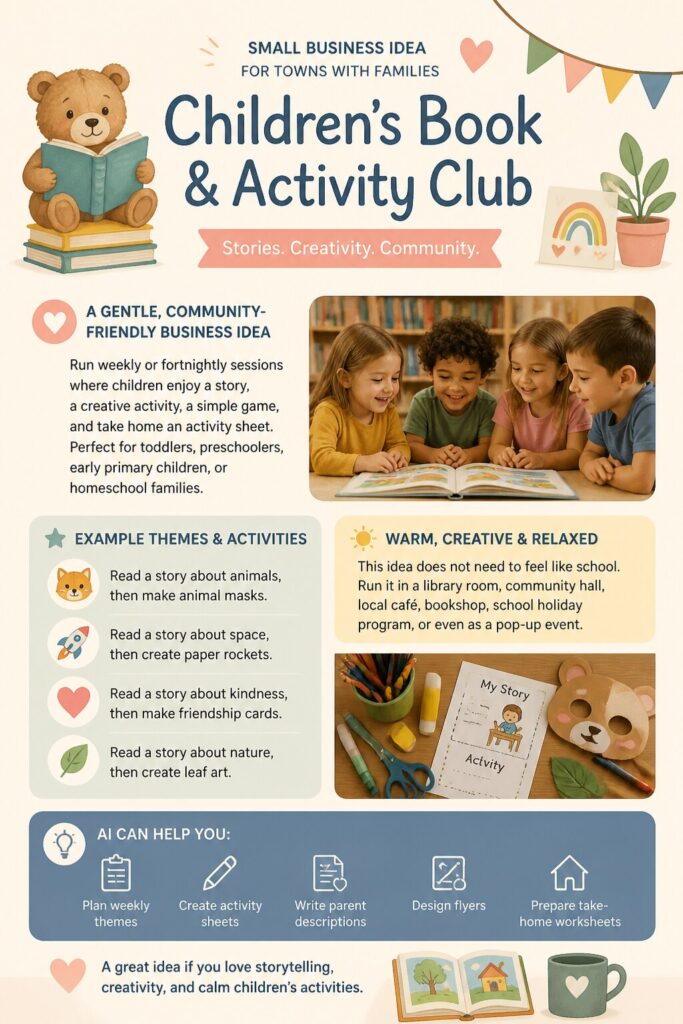
A children’s book and activity club is a gentle, community-friendly business idea.
You could run weekly or fortnightly sessions where children listen to a story, do a related craft, play a simple game, and take home a small activity sheet.
This could work well for toddlers, preschoolers, early primary school children, or homeschool families.
For example:
- read a story about animals, then make animal masks
- read a story about space, then create paper rockets
- read a story about kindness, then make friendship cards
- read a story about nature, then create leaf art
This idea does not need to feel like school.
It can feel warm, creative, and relaxed.
You could run it in a library room, community hall, local café, bookshop, school holiday program, or even as a pop-up event.
AI can help you plan weekly themes, create activity sheets, write parent descriptions, design flyers, and prepare simple take-home worksheets.
This is a good idea if you enjoy storytelling, creativity, and calm children’s activities.
21. Kid’s sports skill sessions
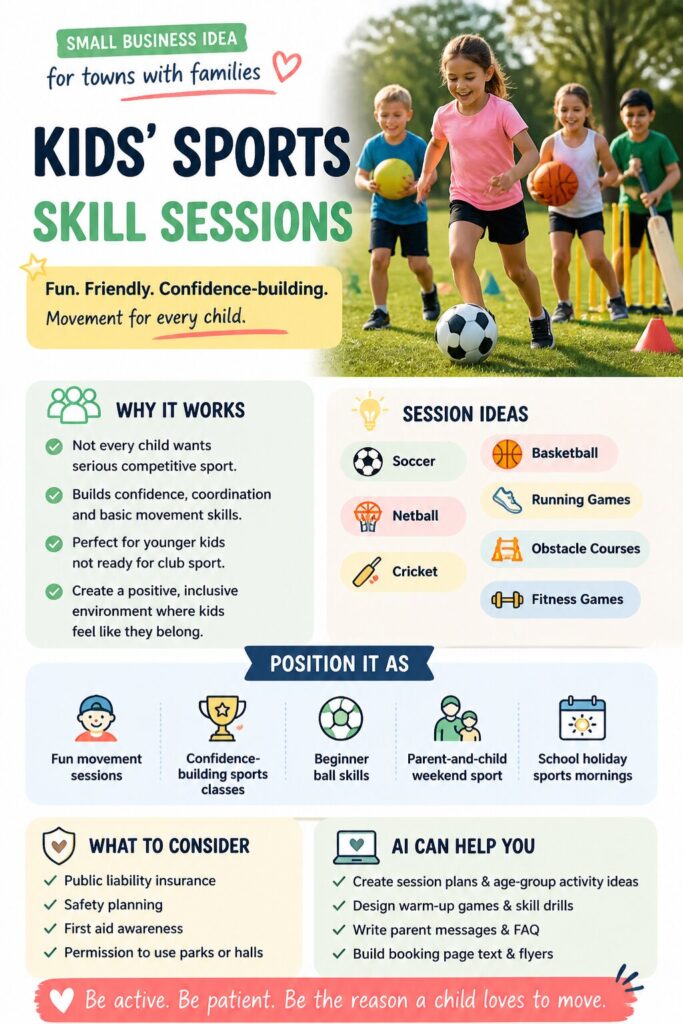
Not every child wants serious competitive sport.
Some children just need a friendly place to build confidence, coordination, and basic movement skills.
A kids’ sports skill session could focus on beginner-level activities such as soccer, netball, cricket, basketball, running games, obstacle courses, or general fitness games.
This can work especially well for younger kids who are not ready for full club sport yet.
The business does not need to be positioned as elite coaching.
It could be positioned as:
- fun movement sessions
- confidence-building sports classes
- beginner ball skills
- parent-and-child weekend sport
- school holiday sports mornings
This idea may need public liability insurance, safety planning, first aid awareness, and permission to use parks or halls.
AI can help you create session plans, age-group activity ideas, warm-up games, parent messages, booking page text, and simple flyers.
This idea works best if you are active, patient, and good at making kids feel included.
22. Baby and toddler music classes
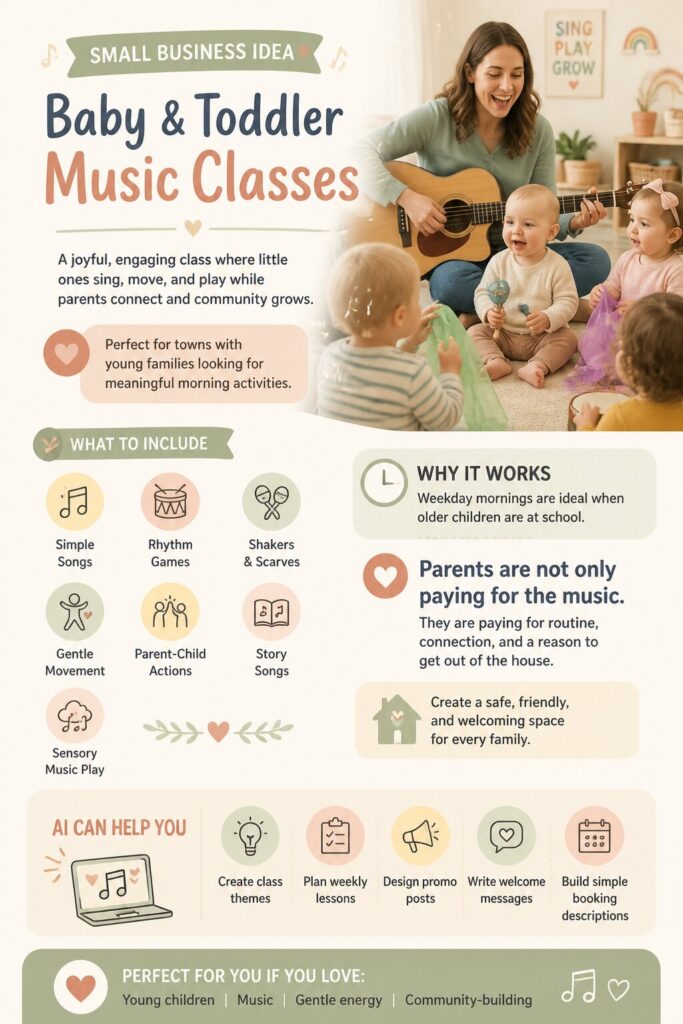
Baby and toddler music classes can be a lovely small business idea in towns with many young families.
Parents often look for regular morning activities where their little ones can move, sing, clap, dance, and interact with other children.
These sessions could include:
- simple songs
- rhythm games
- shakers
- scarves
- gentle movement
- parent-child actions
- story songs
- sensory music play
This type of business can work well on weekday mornings, especially when older children are at school.
The important thing is to make the environment feel safe, friendly, and not intimidating.
Parents are not only paying for the music.
They are paying for routine, connection, and a reason to get out of the house.
AI can help you create class themes, weekly lesson plans, promotional posts, welcome messages, and simple booking descriptions.
This idea suits someone who enjoys young children, music, gentle energy, and community-building.
23. Local parent support workshops
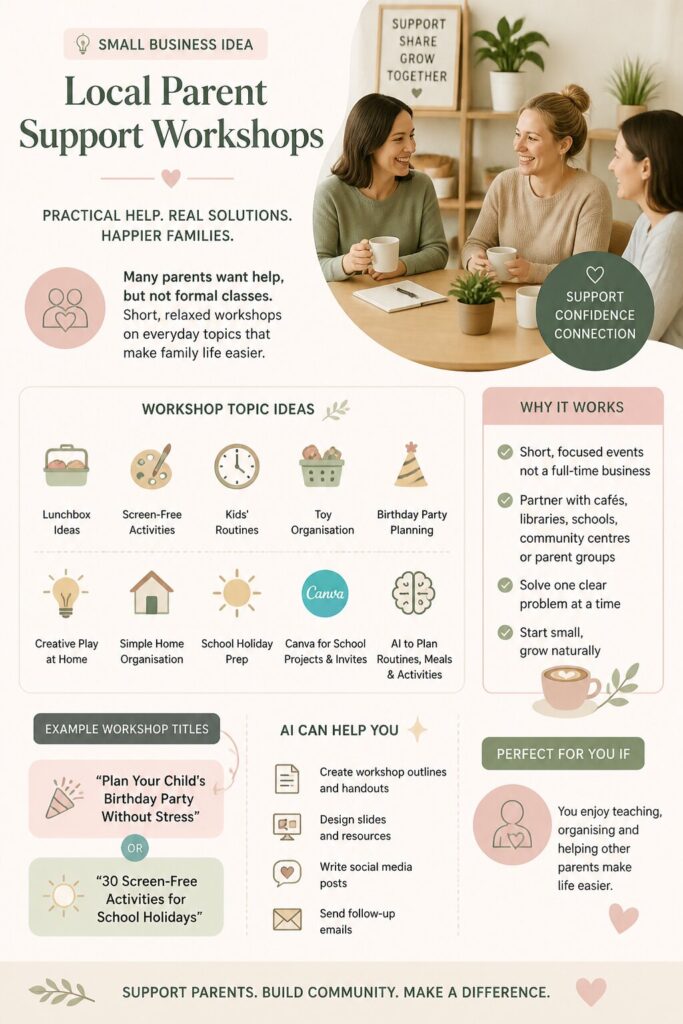
Many parents want help, but they do not always want formal classes.
A local parent support workshop could cover simple everyday topics that make family life easier.
Examples include:
- lunchbox ideas
- screen-free activity ideas
- kids’ routines
- toy organisation
- birthday party planning
- creative play at home
- simple home organisation
- preparing for school holidays
- using Canva for school projects or party invitations
- using AI to plan family routines, meals, or activities
This idea works well because it can be run as a small event, not a full business at the beginning.
You could partner with a café, community centre, library, school group, or local parent network.
The workshop does not need to be perfect.
It just needs to solve one clear problem.
For example:
“Plan Your Child’s Birthday Party Without Stress”
or
“30 Screen-Free Activities for School Holidays”
AI can help you create workshop outlines, handouts, slides, social media posts, and follow-up emails.
This is a good idea for someone who likes teaching, organising, or helping other parents make life easier.
24. Kids’ personalised gift business
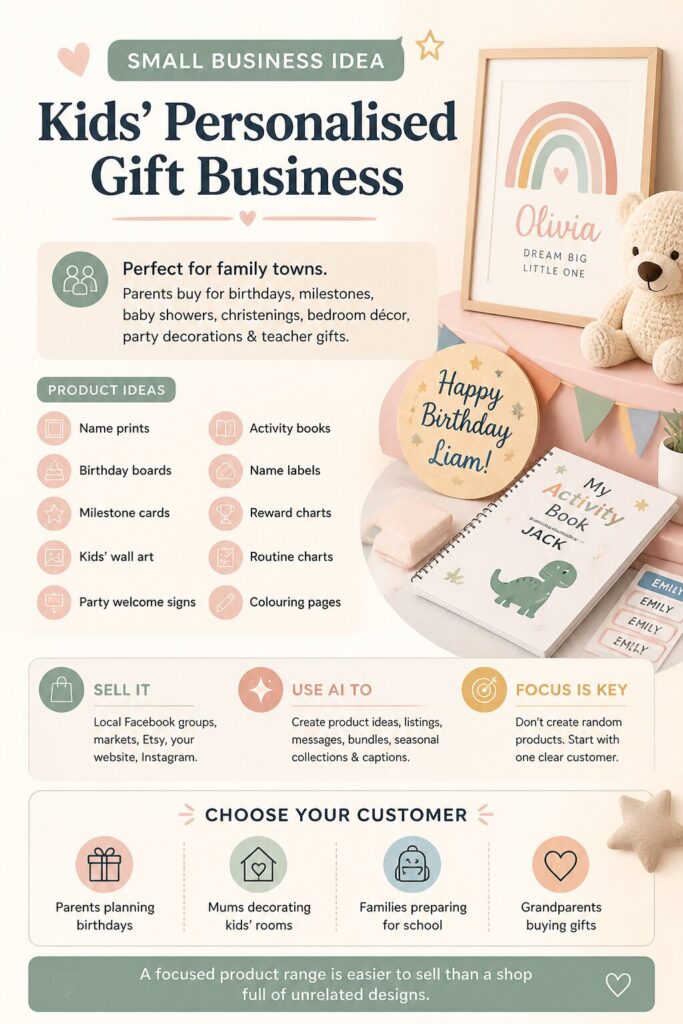
A personalised gift business can work well in family towns because parents often buy for birthdays, school milestones, baby showers, christenings, bedroom décor, party decorations, and end-of-year teacher gifts.
You could create products such as:
- personalised name prints
- birthday boards
- milestone cards
- kids’ room wall art
- party welcome signs
- custom activity books
- name labels
- reward charts
- routine charts
- personalised colouring pages
This is a strong idea for creative people because many products can be designed in Canva, Procreate, Illustrator, or other design tools.
You can sell through local Facebook groups, markets, Etsy, your own website, or Instagram.
AI can help you create product ideas, listing descriptions, customer messages, product bundles, seasonal collections, and social media captions.
The key is not to create too many random products.
Start with one clear customer.
For example:
- parents planning birthdays
- mums decorating kids’ rooms
- families preparing for school
- grandparents buying personalised gifts
A focused product range is easier to sell than a shop full of unrelated designs.
25. Weekend family experience boxes
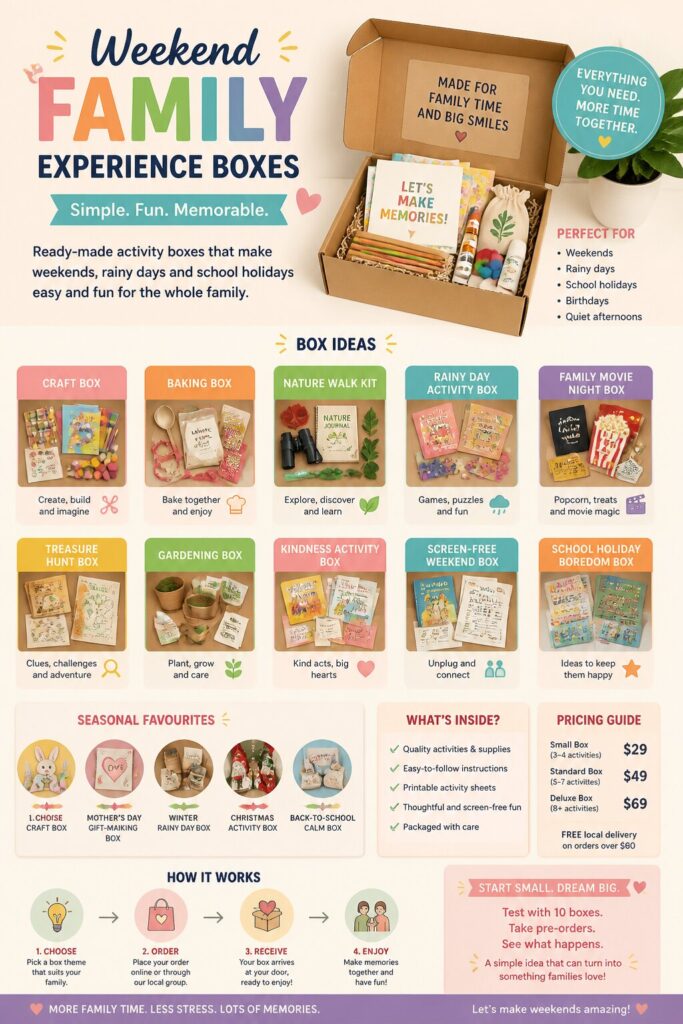
A weekend family experience box is a simple product idea built around one problem:
Parents want something easy and fun to do with the kids at home.
You could create ready-made activity boxes for weekends, rainy days, school holidays, birthdays, or quiet afternoons.
Examples include:
- craft box
- baking box
- nature walk kit
- rainy day activity box
- family movie night box
- treasure hunt box
- gardening box
- kindness activity box
- screen-free weekend box
- school holiday boredom box
This idea can start very small.
You do not need hundreds of boxes.
You could test with 10 boxes first.
Post in a local parent group, take pre-orders, and see what happens.
The best part is that this idea can become seasonal.
For example:
- Easter craft box
- Mother’s Day gift-making box
- winter rainy day box
- Christmas activity box
- back-to-school calm box
AI can help you plan the box theme, write instructions, create printable activity sheets, name each box, price the offer, and write social media posts.
This idea is especially good if you enjoy packaging, design, kids’ activities, and creating small physical products.
Not every idea on this list will suit your town, your budget, or your personality.
That is normal.
The goal is not to choose the idea that sounds the most exciting.
The goal is to choose the idea that has a real customer, a clear problem, a simple first version, and a way to test demand before you spend too much money.
That is where AI becomes helpful again.
Not every idea on this list will suit your town, your budget, or your personality.
That is normal.
The goal is not to choose the idea that sounds the most exciting.
The goal is to choose the idea that has a real customer, a clear problem, a simple first version, and a way to test demand before you spend too much money.
That is where AI becomes helpful again.
How to use AI to compare your ideas
Once you have a list of ideas, do not choose based only on excitement.
Excitement is good.
But you also need to compare the ideas like a business owner.
Use this prompt:
AI Prompt:
Compare these business ideas for a small town with many families: [paste your ideas]. Create a table with these columns: startup cost, difficulty level, demand from families, repeat purchase potential, weekend potential, risks, skills needed, and easiest way to test. Then rank the top 5 ideas for a beginner with a small budget.
This will quickly show you which ideas are light and testable, and which ideas are heavy and risky.
For example, a kids craft pop-up might be easier to test than a full indoor activity centre.
A party box rental business might be easier than opening a permanent party venue.
A local kids activity directory might be easier than managing a physical location.
A small test is not a failure.
A small test is how smart businesses start.
How to test your business idea before spending money
This is the most important section.
A Reddit commenter gave the best advice in the whole thread: nobody online truly knows your town, so you should ask people locally, run surveys, and spend money testing what people actually want before investing properly.
That advice is boring.
And also very correct.
Before you rent a shop, buy equipment, print signs, or build a full brand, test the idea.
Here are simple ways to test:
Create a local survey
Ask 5 to 7 simple questions:
- What activities do you wish existed for kids in this town?
- What age are your children?
- What days and times suit you best?
- How much would you pay for a 1-hour activity?
- Would you prefer indoor, outdoor, or at-home activities?
- What birthday party services do you wish were available?
- Would you like to join a waitlist for a trial session?
Use AI to help you write the questions.
Post in local Facebook groups
Do not spam.
Ask politely.
For example:
I’m researching a possible kids craft workshop in our local area and would love parent feedback. Nothing is for sale yet. I’m trying to understand what families actually need. Would a Saturday morning creative session for kids be useful in this area?
That feels much better than posting a full advertisement too early.
Run one trial event
Instead of launching a business, run one test.
Examples:
- one craft morning
- one mini photography day
- one party styling trial
- one toddler sensory session
- one school holiday workshop
- one family picnic setup
- one local activity guide PDF
Then watch what happens.
Do people book?
Do they ask questions?
Do they share it?
Do they come back?
Do they say it is too expensive?
Do they ask for another date?
Real feedback is better than guessing.
Partner with another local business
This is one of the smartest ways to reduce risk.
Instead of renting your own space, partner with:
- cafes
- community halls
- churches
- libraries
- dance studios
- play centres
- markets
- breweries during quiet hours
- schools, where allowed
- local creative studios
This is especially useful for workshops and events.
You bring the activity.
They provide the space.
Both sides may benefit.
Important note for Australian readers
If you are searching for small business ideas for towns with families in Australia, check the practical rules early.
Some ideas are simple.
Some are not.
Business.gov.au recommends researching your market, customers, competitors, products, and services so you can make better business decisions before you act.
If you are starting a business in Australia, business.gov.au also lists steps such as researching your market, planning risks, registering your business, getting an ABN, registering a business name, and checking licences and permits.
If your idea involves food, check food safety rules.
If your idea involves childcare or family day care, be extra careful. Family day care and childcare-related services have formal requirements. ACECQA information notes that new family day care educators must hold an approved Certificate III level or higher qualification before commencing in a family day care service.
This does not mean you should avoid all family-related ideas.
It just means you should know the difference between:
- a kids craft event
- a birthday party service
- a food business
- a childcare business
- a regulated education and care service
They are not all the same.
When in doubt, check your local council, insurance provider, and relevant Australian business guidance before launching.
The best small business idea is the one you can test this month
It is easy to dream about the big version.
The beautiful kids studio.
The perfect café.
The full activity centre.
The outdoor adventure park.
The party venue everyone talks about.
But most successful small businesses do not start perfectly.
They start with one small test.
One flyer.
One booking form.
One weekend session.
One local survey.
One Facebook post.
One trial customer.
One simple offer.
AI can help you move faster, but it should not replace local common sense.
Use AI to brainstorm.
Use AI to compare ideas.
Use AI to write surveys.
Use AI to make flyers.
Use AI to plan your first test.
Use AI to create simple marketing.
But use real people to confirm the demand.
Because your town already gives you clues.
Look at where families go.
Look at what parents complain about.
Look at what gets booked out.
Look at what is missing during school holidays.
Look at what people travel to another suburb for.
Look at what local Facebook groups keep asking for.
That is where the real business idea is hiding.
Not in a random list.
Not in a trend.
Not in what worked in someone else’s town.
The right idea is somewhere between:
what families need, what you can offer, what people will pay for, and what you can test without risking too much money.
That is the sweet spot.
And with the help of AI, finding that sweet spot becomes much easier.
Copy-and-paste AI prompt to finish with
Before you choose your idea, try this:
I want to start a small business in a town with many families. Act like a small business advisor. Ask me 10 questions about my town, my skills, my budget, my available time, local competition, and what families need. After I answer, suggest 5 realistic business ideas I can test in the next 30 days without spending too much money.
This is a much better way to use AI.
Not as a magic answer machine.
But as a guide that helps you think clearly.
Because the goal is not just to find a business idea.
The goal is to find an idea that real families in your town actually want.
Final thought
If you are looking for small business ideas for a town with families, start small.
Do not begin with rent, stock, signage, and a huge launch.
Begin with curiosity.
Ask parents.
Watch local behaviour.
Use AI to organise your ideas.
Test one small offer.
Learn from the response.
Then improve.
That is how a simple idea becomes a real small business.
Not overnight.
But step by step.