
Product-based small businesses can use AI to save time on product descriptions, customer replies, social media captions, ad copy, SEO blog ideas, product page FAQs, review summaries, email drafts, and weekly content planning. The easiest way to start is to choose one product, give AI the real product details, and use it to turn that product into a description, title ideas, captions, FAQs, emails, ads, and blog topics.
If you run a small product business, you already know this feeling.
You finally sit down to work on your shop.
Maybe you sell handmade candles, jewellery, skincare, art prints, digital downloads, home decor, kids’ products, gift boxes, stationery, or something beautifully niche that only makes sense to your kind of customer.
You want to create.
You want to improve your product photos.
You want to plan your next launch.
But instead, you end up staring at a blank product description.
Then you need an Instagram caption.
Then a customer asks the same shipping question again.
Then you realise you have not emailed your list in three weeks.
Suddenly, running a product business feels less like building a creative brand and more like feeding a never-ending content machine.
That is where AI can actually help.
Not in a scary, robotic way.
More like a quiet assistant sitting beside you, helping you get the repetitive writing out of your head and onto the page.
The key is not to ask AI for random ideas.
The key is to give AI one real product and use it properly.
That is what this guide will show you.
The Simple Idea: One Product Can Become Many Pieces of Content
Here is the part many small business owners miss.
You do not need to create from scratch every day.
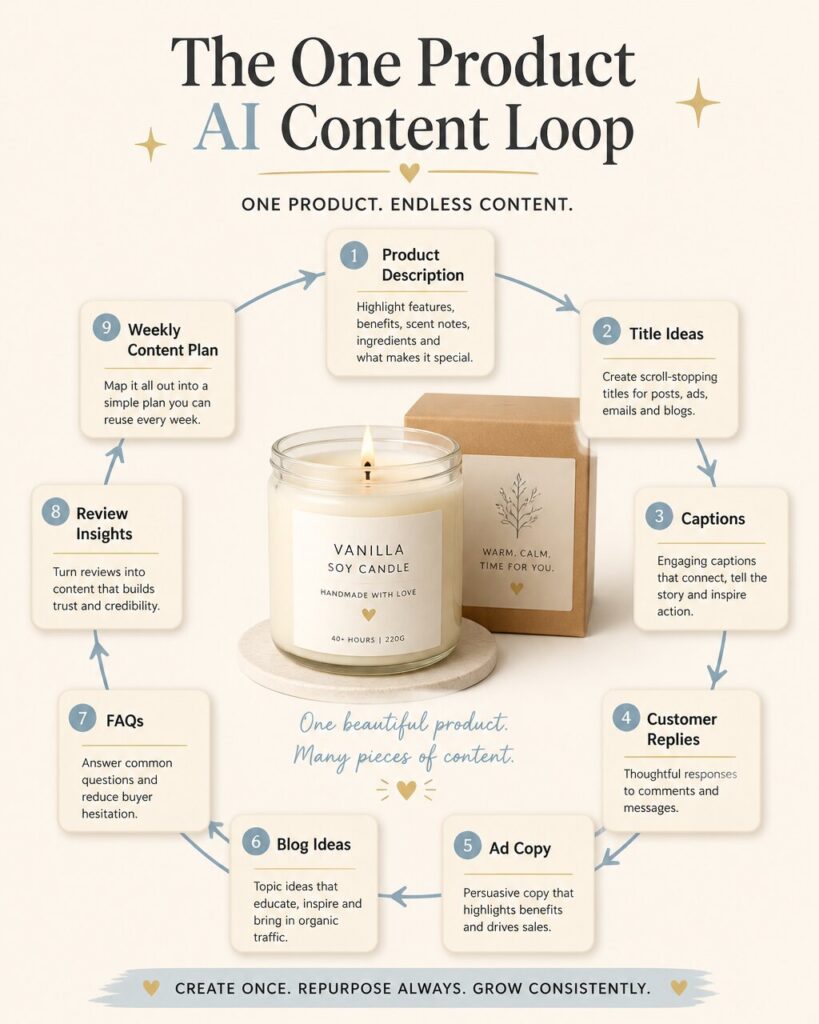
One product can become:
| One product can become | Example |
|---|---|
| A product description | For your website, Etsy, Shopify, or WooCommerce store |
| Product title ideas | For search-friendly listings |
| Customer reply templates | For shipping, returns, custom orders, and gifting |
| Social media captions | For Instagram, Facebook, Pinterest, or TikTok |
| Ad copy | For simple promotions or product launches |
| Blog post ideas | For SEO traffic |
| Product FAQs | To reduce buyer hesitation |
| Review-based messages | To use customer language in your marketing |
| Weekly content plan | So you are not guessing what to post every day |
This is what I call The One Product AI Content Loop.
You choose one product.
You collect the real details.
Then you ask AI to help you create the small pieces of writing and planning that usually slow you down.
You are not asking AI to “run your business.”
You are using AI to stop starting from zero.
What Is a Product-Based Small Business?
A product-based small business sells physical or digital products instead of mainly selling services.
This could include:
- Handmade candles
- Wax melts
- Jewellery
- Skincare
- Soap
- Clothing
- Art prints
- Home decor
- Digital planners
- Printable worksheets
- Gift boxes
- Pet products
- Kids’ products
- Stationery
- Craft supplies
- Canva templates
- Small-batch food products
Some businesses sell through Etsy.
Some use Shopify, WooCommerce, Instagram, Facebook, markets, Pinterest, or their own website.
The platform does not matter as much as the problem.
You have products to sell, but you also need words, descriptions, content, emails, and marketing ideas to help people understand why they should buy from you.
That is where AI becomes useful.
Why AI Is Useful for Product-Based Small Businesses
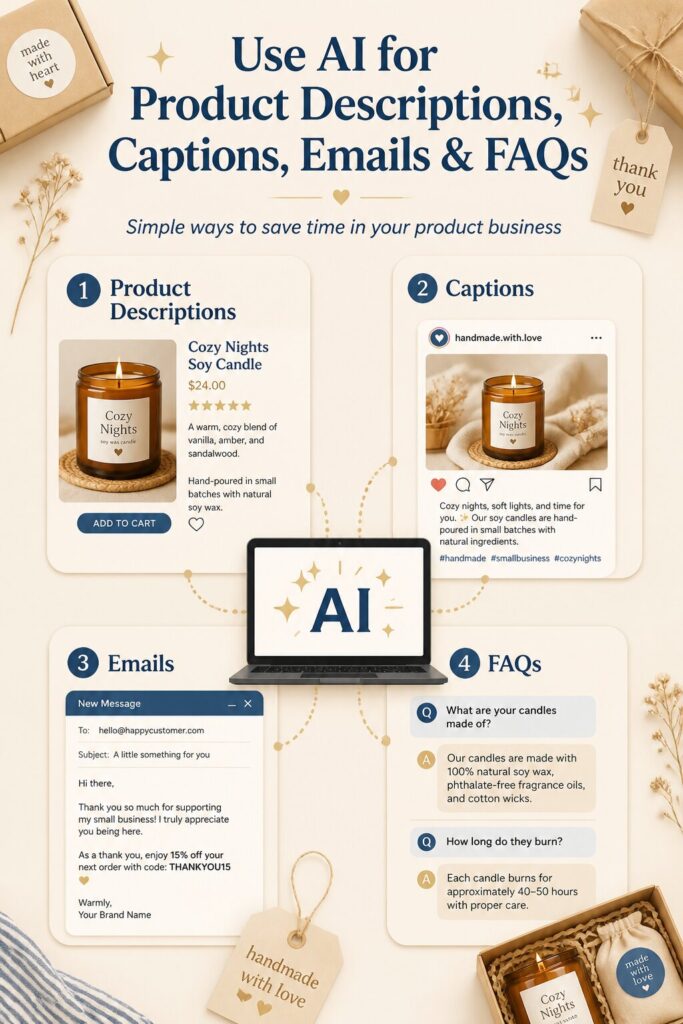
Most small business owners are not stuck because they do not care.
They are stuck because they are doing everything.
You might be the product maker, photographer, customer support person, website updater, social media manager, copywriter, packer, designer, and marketing person all at once.
That is a lot for one person.
AI can help with the writing and planning tasks that repeat every week.
Things like:
- Writing product descriptions
- Creating product title ideas
- Drafting customer replies
- Brainstorming captions
- Writing simple ad copy
- Planning blog ideas
- Creating email drafts
- Building FAQ sections
- Turning reviews into marketing messages
The honest part?
AI will not automatically make your product better.
It will not understand your customer better than you do.
It will not know your shipping rules, product quality, handmade process, or brand feeling unless you tell it.
But it can help you create a first draft much faster.
And for many small business owners, that is already a big win.
A Simple Example: Linen & Light
Let’s use a simple example throughout this article.
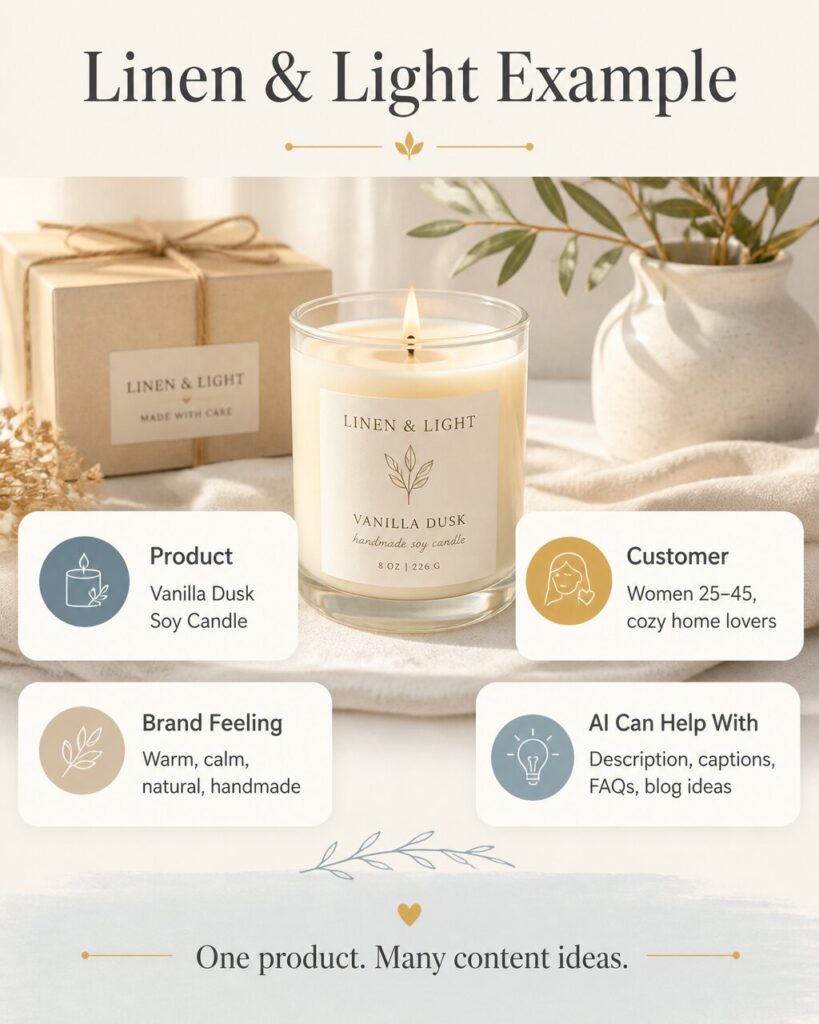
Imagine a small handmade candle brand called Linen & Light.
The business sells:
- Handmade soy candles
- Wax melts
- Gift boxes
The target customer is:
- Women aged 25 to 45
- People who like cozy homes
- People buying thoughtful gifts
- People who enjoy calm evenings and soft self-care routines
The brand feeling is:
- Warm
- Calm
- Natural
- Soft
- Handmade
- Slightly premium
- Not childish
- Not loud
Now let’s say Linen & Light has one product:
Vanilla Dusk Soy Candle
Basic product notes:
- Handmade soy candle
- Vanilla scent
- Simple glass jar
- Soft, warm scent
- Good for bedrooms, quiet evenings, self-care nights, and gifting
- Brand tone: warm, calm, natural, not too salesy
- Avoid: medical claims, exaggerated promises, luxury clichés
With only these details, AI can help create many useful pieces of content.
That is the One Product AI Content Loop in action.
1. Use AI to Write Better Product Descriptions
Product descriptions are probably the easiest place to start.
A good product description explains:
- What the product is
- Who it is for
- Why someone might want it
- How it feels to use
- What makes it useful or giftable
But writing product descriptions can feel strangely difficult.
You know your product.
You made it, packed it, photographed it, and probably thought about it for weeks.
Then you sit down to write and somehow everything comes out flat.
Weak product description
Here is a very basic version:
Vanilla soy candle in a glass jar.
It is true.
But it does not help the customer feel anything.
It also does not explain when someone might use it or why it might make a good gift.
Better AI prompt
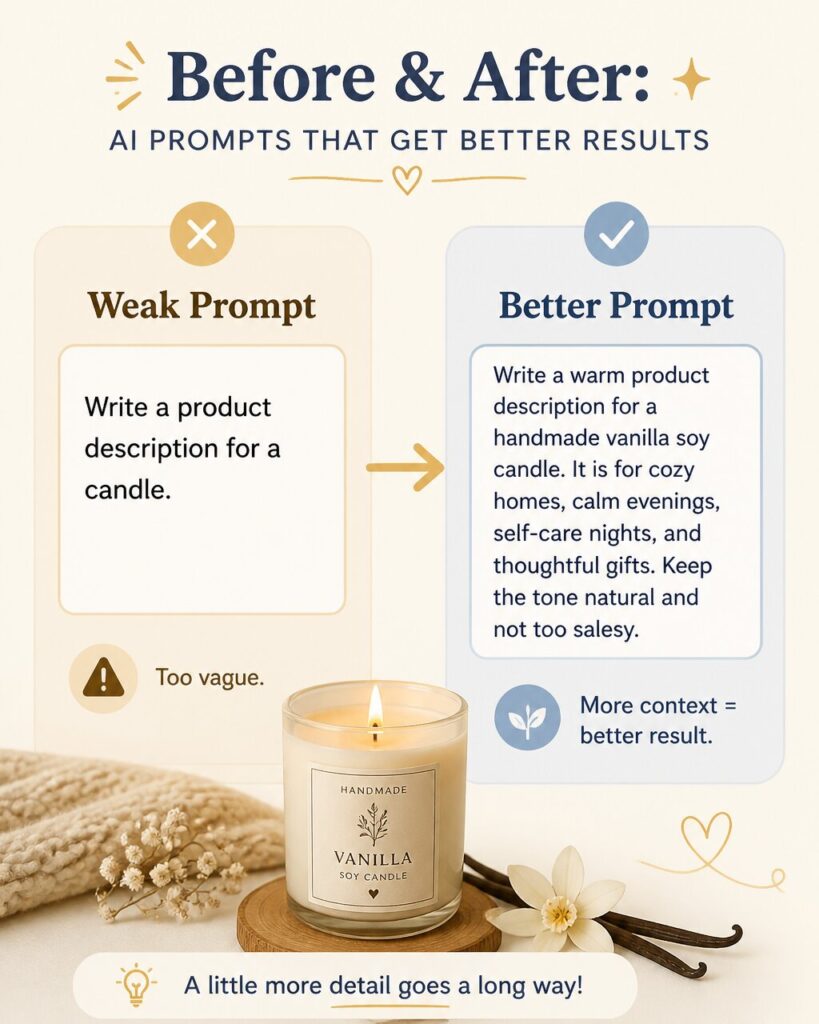
Instead of asking:
Write a product description for a candle.
Give AI the real context:
Write a warm, simple product description for a handmade vanilla soy candle called Vanilla Dusk. It is for women who like cozy homes, calm evenings, and thoughtful gifts. The candle comes in a simple glass jar and has a soft vanilla scent. Keep the tone natural, gentle, and not too salesy. Mention bedrooms, self-care nights, quiet evenings, and gifting. Do not make medical claims or exaggerated promises.
Improved product description
AI could help you create something like:
Vanilla Dusk is a handmade soy candle created for slow evenings, cozy bedrooms, and thoughtful gifting. With a soft vanilla scent and a simple glass jar, it brings a warm, calm feeling to your space without feeling heavy or overpowering. Light it during a quiet night in, add it to a self-care routine, or gift it to someone who loves simple, comforting home details.
This is not perfect forever.
You may still edit it.
But it is a much better starting point than a blank page.
What changed?
The better prompt included:
- Product name
- Product type
- Target customer
- Brand feeling
- Use cases
- Tone of voice
- What not to say
That is why the output feels less generic.
Before you ask AI for product descriptions, give it something real to work with.
2. Use AI to Create Product Titles and SEO-Friendly Listing Names
Product titles help customers quickly understand what you are selling.
They also help your listings appear in search on platforms like Etsy, Shopify, Google, Pinterest, or your own website.
This is where many small business owners go too far in one direction.
A title like this is too vague:
Candle
But this is too much:
Handmade Natural Soy Wax Vanilla Candle Gift for Women Birthday Relaxing Cozy Home Decor Bedroom Luxury Scented Candle
It is trying too hard.
AI can help you find the middle ground.
Better prompt
Give me 20 product title ideas for a handmade vanilla soy candle called Vanilla Dusk. Make them clear, natural, and search-friendly without keyword stuffing. The product is suitable for cozy homes, self-care nights, bedrooms, and thoughtful gifts.
Example title ideas
- Vanilla Dusk Soy Candle for Cozy Evenings
- Handmade Vanilla Candle for Calm Nights
- Soft Vanilla Soy Candle Gift for Her
- Vanilla Soy Candle for Bedroom and Self-Care
- Handmade Candle for Cozy Home Gifting
- Soft Vanilla Candle in Glass Jar
- Calm Evening Vanilla Soy Candle
A small detail, but it matters.
You are not using AI to stuff keywords everywhere.
You are using it to find clear language your customer might understand and search for.
3. Use AI to Reply to Common Customer Questions Faster
Customer replies are one of the most practical AI use cases for product-based small businesses.
Most customers ask similar questions again and again.
They may ask:
- When will my order arrive?
- Do you ship to my area?
- Can I customise this?
- Can I add a gift note?
- Is this suitable for sensitive skin?
- What if my item arrives damaged?
- Can I return it?
- Do you offer wholesale?
You can write these replies yourself every time.
Or you can use AI to create a small reply bank.
Example prompt
Write a friendly customer email reply. The customer is asking when their handmade candle order will arrive. Explain that processing takes 2 to 3 business days and shipping updates will be emailed after dispatch. Keep the tone warm, helpful, and clear.
Example reply
Hi [Name], thanks so much for your order. Your candle will be packed and processed within 2 to 3 business days. Once it has been dispatched, you will receive a shipping update by email with the tracking details. Thank you again for supporting my small business.
You still need to check the facts.
AI should not guess your shipping times, refund policy, product ingredients, or safety information.
But it can help you write the message in a calm and helpful way.
This is especially useful on days when you are tired and do not want to rewrite the same thing again.
4. Use AI to Turn One Product Into Social Media Captions
A lot of product-based business owners get stuck on social media because they think they need a brand-new idea every day.
You do not.
You need different angles for the same product.
One candle can become:
- A launch post
- A behind-the-scenes post
- A gift idea post
- A self-care post
- A cozy home post
- A product benefit post
- A packaging post
- A seasonal post
- A maker story post
- A customer problem post
That is already a lot of content from one product.
The trick is to ask AI for angles before asking for captions.
Weak prompt
Write an Instagram caption for my candle.
This usually gives you something generic.
Better prompt
Give me 10 Instagram caption angles for a handmade vanilla soy candle called Vanilla Dusk. Create different angles: gift idea, cozy evening, self-care, behind the scenes, product benefits, packaging, small business story, customer problem, seasonal post, and soft launch. Keep the tone warm and natural.
Example output angles
| Angle | Caption idea |
|---|---|
| Gift idea | A soft vanilla candle for someone who deserves a quiet moment |
| Cozy evening | For the nights when you want the house to feel slower |
| Self-care | A small candle, a clean room, and five minutes to breathe |
| Behind the scenes | Poured in small batches with a soft vanilla scent |
| Customer problem | When you want a gift that feels thoughtful but not overdone |
Now you have more than captions.
You have content direction.
That is much more useful.
5. Use AI to Write Simple Ad Copy Without Overthinking
Ad copy can feel intimidating if you do not see yourself as a marketer.
You know your product is good.
But the second you sit down to write an ad, you start second-guessing everything.
Is it too pushy?
Too boring?
Too vague?
Too salesy?
AI can help you create several first drafts quickly.
Example prompt
Write 10 short ad copy options for a handmade candle gift box. The target customer is a woman aged 25 to 45 buying a thoughtful birthday, thank-you, or self-care gift. Keep the tone warm, calm, and not too pushy.
Example ad copy ideas
- A soft, thoughtful gift for someone who loves cozy nights in.
- Handmade candles for quiet evenings, small rituals, and simple gifting.
- Send a little calm in a box with a handmade candle gift set.
- For birthdays, thank-you gifts, or the friend who deserves a slower evening.
- A warm little gift for someone who loves home, comfort, and soft scents.
The goal is not to let AI decide your marketing.
The goal is to give yourself options faster.
You choose the line that feels right.
Then you edit it so it sounds like your brand.
6. Use AI to Brainstorm SEO Blog Ideas
Many product-based small businesses ignore blogging because it feels like extra work.
And honestly, it can be extra work.
But a helpful blog post can bring the right people to your shop over time, especially if the topic connects naturally to your product and your customer’s life.
You do not need random blog posts.
You need useful posts your customer might actually search for.
For a candle business, this could include:
- Best candle scents for a relaxing bedroom
- How to create a cozy evening routine
- Soy candles vs paraffin candles
- Candle care tips for beginners
- Gift ideas for teachers
- How to choose a candle for a small room
- Self-care gift box ideas
- How to make your home feel cozy on a budget
Better prompt
I sell handmade soy candles for women who like cozy homes, self-care, and thoughtful gifts. Give me 30 helpful blog post ideas that could attract my ideal customer. Group them into gift guides, candle care, cozy home ideas, self-care, and seasonal content. Keep the topics beginner-friendly and connected to my products without sounding too salesy.
Example blog idea groups
| Category | Blog ideas |
|---|---|
| Gift guides | Thoughtful candle gift ideas for teachers, friends, or hosts |
| Candle care | How to make your candle last longer |
| Cozy home | How to make your bedroom feel calmer at night |
| Self-care | Simple evening routine ideas for busy women |
| Seasonal | Cozy winter gift box ideas for candle lovers |
This is more useful than asking AI for “blog ideas.”
You are giving it your product, your customer, and your categories.
That creates a clearer content plan.
7. Use AI to Create FAQ Sections for Product Pages
A FAQ section can do a lot of quiet work.
Customers often do not buy because they still have small unanswered questions.
They may wonder:
- What size is it?
- How long does it last?
- Is it handmade?
- Is it suitable as a gift?
- How strong is the scent?
- How do I care for it?
- Can I return it?
- How long does shipping take?
AI can help you draft these questions and answers.
Example prompt
Create a helpful FAQ section for a handmade soy candle product page. Include questions about size, burn time, scent strength, gifting, care instructions, shipping, and returns. Keep the answers clear and simple. Do not invent details. Use placeholders where the business owner needs to add exact information.
Example FAQ output
How long does the candle burn?
Burn time depends on the candle size. Add your exact burn time here based on your product testing.
Is this candle suitable as a gift?
Yes, this candle is suitable for thoughtful gifting, self-care boxes, birthdays, thank-you gifts, or cozy home lovers.
How should I care for the candle?
Trim the wick before each use and follow the safety instructions provided with your candle.
Notice the instruction:
Do not invent details.
That matters.
AI should not guess burn time, ingredients, safety rules, return policies, or shipping costs.
But it can help you build the structure.
You fill in the real facts.
8. Use AI to Learn From Customer Reviews
Your customer reviews are full of marketing language.
Sometimes customers describe your product better than you do.
They might say:
- “Smells soft, not too strong.”
- “Perfect gift for my sister.”
- “The packaging felt premium.”
- “Looks beautiful on my bedside table.”
- “Exactly what I wanted for a cozy night in.”
- “Arrived quickly and felt handmade.”
Those phrases are useful.
You can use them in:
- Product descriptions
- Social captions
- Email subject lines
- Ad copy
- Pinterest pin titles
- Website headlines
AI can help you find patterns in your reviews.
Example prompt
Summarise the main reasons customers like this product. Group the feedback into themes like scent, packaging, gifting, quality, and emotional feeling. Then suggest wording I can use in product descriptions and social media captions. Do not invent reviews. Only use the review text I provide.
What you might discover
You might think your candle is mainly about scent.
But your customers may keep mentioning the packaging and giftability.
That tells you something useful.
Maybe your product page should focus more on:
- Thoughtful gifting
- Beautiful packaging
- Soft scent
- Cozy bedroom use
- Handmade feel
AI helps you notice those patterns faster.
But the insight still comes from your real customers.
9. Use AI to Plan Weekly Content in One Sitting
One of the best uses of AI is getting ahead on content.
Not months ahead.
Just enough to stop waking up every morning thinking:
“What am I supposed to post today?”
A simple weekly structure could look like this:
| Day | Content angle |
|---|---|
| Monday | Product education |
| Tuesday | Behind the scenes |
| Wednesday | Customer problem |
| Thursday | Gift idea |
| Friday | Product feature |
| Saturday | Lifestyle post |
| Sunday | Email or blog idea |
Now you can ask AI to build around that structure.
Example prompt
I sell handmade vanilla soy candles. Create a 7-day content plan for Instagram, Pinterest, and email. Use this structure: Monday product education, Tuesday behind the scenes, Wednesday customer problem, Thursday gift idea, Friday product feature, Saturday lifestyle post, Sunday email or blog idea. Include one idea per day, a short caption angle, and a simple call to action. Keep the tone warm and suitable for a small handmade brand.
Example weekly content plan
| Day | Idea | CTA |
|---|---|---|
| Monday | How to use a vanilla candle in an evening routine | Save this for your next quiet night |
| Tuesday | Show the candle being packed | Follow for more handmade behind the scenes |
| Wednesday | “Need a gift that feels thoughtful but not too much?” | View the Vanilla Dusk candle |
| Thursday | Candle gift idea for a friend who needs rest | Send this to someone who loves cozy gifts |
| Friday | Product feature: soft vanilla scent in a simple glass jar | Shop the candle |
| Saturday | Cozy bedside table styling idea | Save this home idea |
| Sunday | Email idea: 3 ways to make Sunday night feel calmer | Join the email list |
This is not a huge content system.
That is the point.
Small business owners do not always need a complicated dashboard.
Sometimes you just need a simple plan for the week.
The One Product AI Content Loop
Here is the full workflow in one place.
Choose one product.
Then ask AI to help you create:
- A product description
- Product title ideas
- Customer reply templates
- Social media caption angles
- Simple ad copy
- SEO blog ideas
- Product page FAQs
- Review-based marketing messages
- A weekly content plan
This gives you a reusable system.
You can use it for one candle, one art print, one jewellery piece, one skincare product, one digital planner, one gift box, or one printable worksheet.
You do not need to make AI complicated.
You just need to give it a real product and a clear job.
Turn one product into your next content plan
Get the free One Product AI Content Loop Worksheet and use it to create:
A product description
Product title ideas
Caption angles
FAQ questions
Blog ideas
A simple weekly content plan
Start with one product and build from there.
What You Should Prepare Before Asking AI
Before you ask AI to write anything, collect these details:
| Detail | Example |
|---|---|
| Product name | Vanilla Dusk Soy Candle |
| Product type | Handmade soy candle |
| Target customer | Women who like cozy homes and thoughtful gifts |
| Main use | Bedrooms, self-care nights, quiet evenings |
| Brand feeling | Warm, calm, natural, soft |
| Product details | Vanilla scent, glass jar, handmade |
| Selling point | Simple gift, soft scent, cozy feeling |
| Tone to use | Friendly, gentle, not too salesy |
| Things to avoid | Medical claims, fake promises, luxury clichés |
This is where better AI content begins.
Not with a fancy tool.
With better input.
A prompt is simply the instruction you give to AI.
If your instruction is vague, the result will usually be vague.
If your instruction includes real product details, customer context, and brand feeling, the result gets much better.
What AI Should Not Do for Your Product Business
AI is useful, but it is not responsible for the facts.
You are.
Do not use AI to invent:
- Fake product claims
- Fake ingredients
- Fake reviews
- Fake customer stories
- Fake results
- Fake awards
- Fake handmade processes
- Fake sustainability claims
Be extra careful with:
- Health claims
- Skincare promises
- Safety claims
- Legal policies
- Refund rules
- Shipping timelines
- Product ingredients
- Copyrighted designs
- Customer privacy
A good rule:
Use AI for drafts, ideas, structure, and repurposing.
Use your own judgement for facts, customer trust, and final decisions.
AI can help you write the product page.
It should not decide what is true.
Best AI Prompts for Product-Based Small Businesses
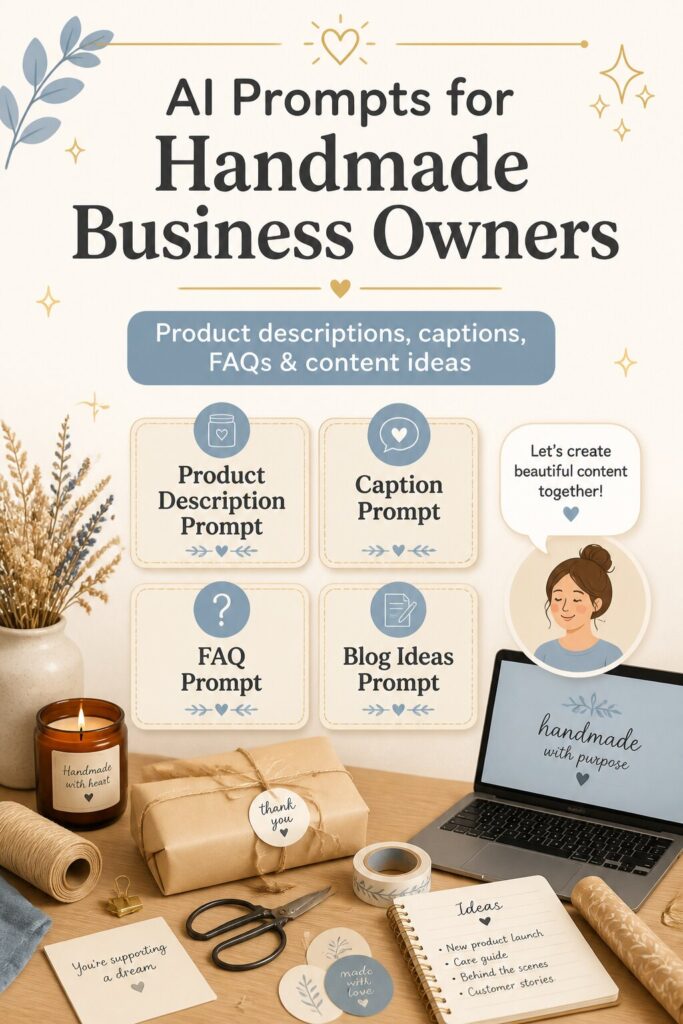
Here are the main prompts from this guide.
You can copy them and adjust the details for your own product.
Product description prompt
Write a clear and warm product description for [product name]. The product is [details]. It is for [target customer]. The brand feeling is [calm / fun / premium / handmade / natural / modern]. Mention [main benefits]. Keep it simple and not too salesy. Do not make exaggerated claims.
Product title prompt
Give me 20 product title ideas for [product name]. Make them clear, natural, and search-friendly without keyword stuffing. The product is suitable for [use cases]. Include a mix of simple titles, gift-focused titles, and SEO-friendly listing names.
Customer reply prompt
Write a friendly customer reply to someone asking about [question]. The answer is [your real answer]. Keep it polite, helpful, and clear. Do not add extra promises or details I did not provide.
Social caption prompt
Give me 10 social media caption angles for [product]. Create different angles: behind the scenes, gift idea, customer problem, product benefit, seasonal post, maker story, lifestyle post, and product education. Keep the tone [brand tone].
Ad copy prompt
Write 10 short ad copy options for [product]. The target customer is [customer type]. The buying reason is [gift / self-care / home decor / problem-solving / seasonal need]. Keep the tone [brand tone] and not too pushy.
Blog idea prompt
I sell [product] for [target customer]. Give me 30 helpful blog post ideas that my ideal customer might search for. Group them into gift guides, how-to posts, product education, seasonal content, and lifestyle ideas.
FAQ prompt
Create a FAQ section for a product page selling [product]. Include questions about size, use, care instructions, shipping, gifting, and returns. Keep answers simple. Do not invent details. Use placeholders where I need to add exact information.
Review summary prompt
Summarise the main reasons customers like this product based only on the reviews I provide. Group the feedback into themes. Then suggest wording I can use in product descriptions, captions, emails, and ads.
Weekly content prompt
Create a 7-day content plan for [product]. Include Instagram ideas, Pinterest title ideas, one email idea, and one blog idea. Keep it simple enough for a solo small business owner.
A Simple Starting Plan
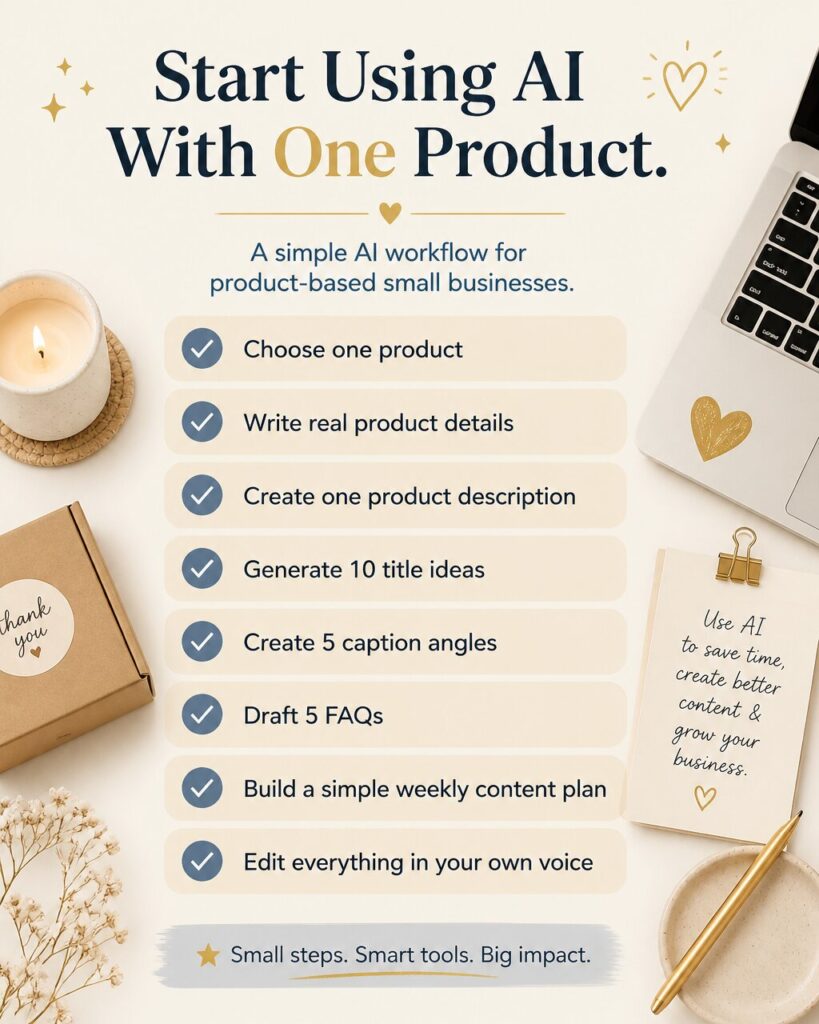
If this feels like a lot, start smaller.
Do not try to use all nine ideas today.
Pick one product.
Then do this:
- Write down the real product details.
- Ask AI for one product description.
- Ask AI for 10 product title ideas.
- Ask AI for 5 Instagram caption angles.
- Ask AI for 5 FAQ questions.
- Edit everything in your own voice.
- Save the best results as templates.
That is enough for the first round.
Once you get comfortable, you can add customer replies, ad copy, blog ideas, review summaries, and weekly planning.
You do not need a huge AI system to save time.
You need one repeatable workflow.
Final Thoughts
You do not need to become an AI expert to benefit from AI.
For product-based small businesses, the best use of AI is often simple.
Use it to write the first draft.
Use it to organise your ideas.
Use it to turn one product into many useful pieces of content.
Use it to stop staring at a blank page.
Product descriptions.
Customer replies.
Captions.
Ad copy.
Blog ideas.
FAQs.
Weekly content planning.
These are not fancy tasks, but they are the daily tasks that keep a product business moving.
When AI saves you even a few hours each week, you can spend more time on the parts of your business that actually need you.
Your taste.
Your product.
Your customer care.
Your creative direction.
Your human touch.
That is where the real business still lives.
Want to try this with your own product?
Download the free One Product AI Content Loop Worksheet.
It helps you take one product and turn it into a product description, title ideas, caption angles, FAQs, blog ideas, and a simple weekly content plan.
No complicated AI setup. No huge content system.
Just one product, one worksheet, and one clear next step.
FAQs
How can AI help a product-based small business?
AI can help a product-based small business write product descriptions, customer replies, social media captions, ad copy, SEO blog ideas, product page FAQs, review summaries, email drafts, and weekly content plans. It is most useful when you give it real product details and edit the output before publishing.
Can AI write product descriptions?
Yes, AI can help write product descriptions. The best results come when you provide the product name, product details, target customer, brand tone, use cases, and claims to avoid. You should always check the final description for accuracy.
Is AI useful for handmade businesses?
Yes, AI can be useful for handmade businesses because it helps with repetitive writing tasks like product descriptions, captions, customer replies, product FAQs, and content ideas. It should support the maker’s voice, not replace it.
Can AI help with Etsy or Shopify listings?
Yes, AI can help brainstorm product titles, descriptions, FAQs, tags, and listing copy for Etsy, Shopify, WooCommerce, or your own website. You still need to check platform rules, product details, and search terms yourself.
What is the easiest way to start using AI in a product business?
The easiest way is to choose one product and ask AI to help create a product description, 10 title ideas, 5 social media caption angles, 5 FAQs, and a simple weekly content plan. This keeps the process small and practical.
What should I not use AI for in my product business?
Do not use AI to invent fake claims, fake ingredients, fake reviews, fake customer stories, or fake results. Be careful with health claims, safety information, skincare promises, refund policies, shipping timelines, and legal wording.