
Finding a niche can feel strangely difficult when you are a creative person.
Not because you have no ideas.
Usually, it is the opposite.
You may have too many ideas, too many styles, too many possible customers, and too many directions you could take.
One day you might think about selling handmade products. The next day, you are thinking about digital downloads, custom designs, workshops, social media content, templates, photography, candles, cakes, illustrations, jewellery, or something completely new.
That is the creative brain.
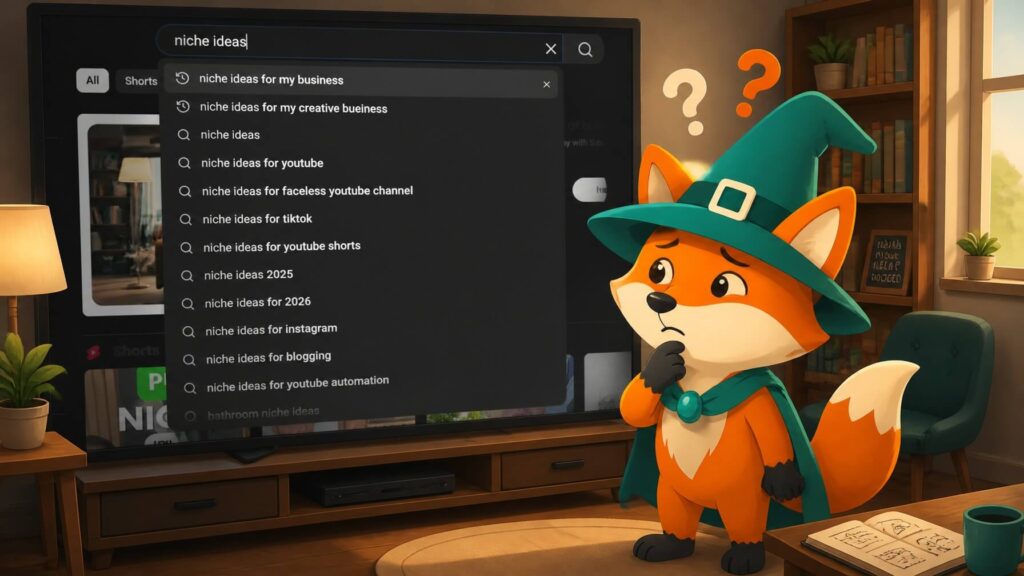
It sees possibilities everywhere.
But when you are trying to build a business, too many possibilities can quickly become confusing.
This is where AI can help.
Not by magically choosing your business for you.
Not by replacing your taste, your creativity, or your experience.
But by helping you organise your ideas, ask better questions, compare different directions, and find a niche that feels clearer, easier to explain, and easier to build around.
You do not need to be technical.
You do not need business experience.
You just need your ideas, a little honesty, and a willingness to explore.
What Is a Niche?
A niche is simply a clear direction for your business.
It helps people understand:
- what you offer
- who it is for
- why they should care
- what makes your work feel different
Many beginners think a niche is just the product they sell.
For example:
That is a product, but it is not a strong niche yet.
A clearer niche would be:
Now it feels more specific.
You understand the product.
You understand the customer.
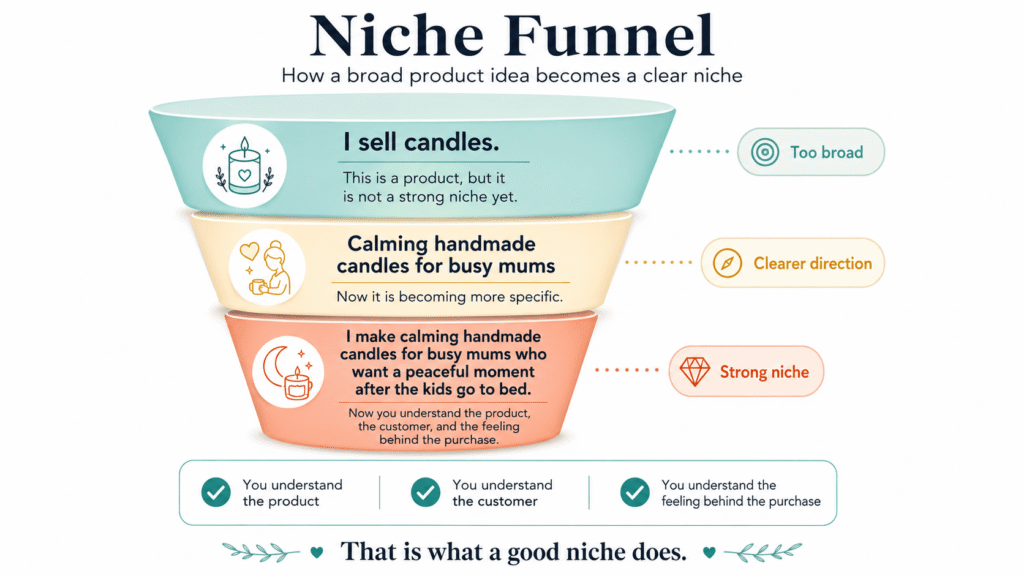
You understand the feeling behind the purchase.
That is what a good niche does.
It turns a general idea into something people can connect with.
Why Creative Business Owners Struggle to Pick a Niche
If you are creative, choosing one niche can feel scary.
You may worry:
What if I choose the wrong thing?
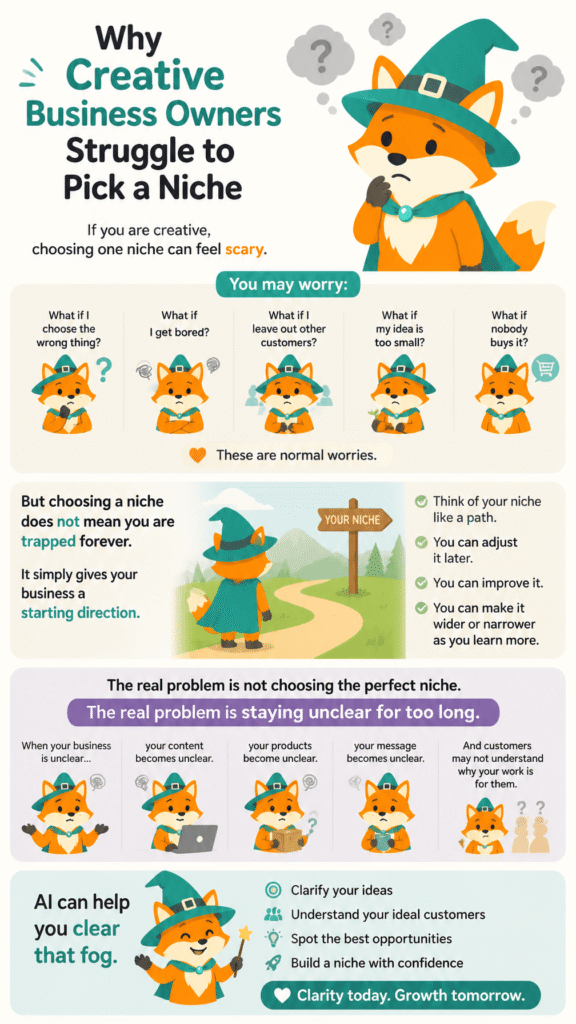
What if I get bored?
What if I leave out other customers?
What if my idea is too small?
What if nobody buys it?
These are normal worries.
But choosing a niche does not mean you are trapped forever.
It simply gives your business a starting direction.
Think of your niche like a path.
You can adjust it later.
You can improve it.
You can make it wider or narrower as you learn more.
The real problem is not choosing the perfect niche.
The real problem is staying unclear for too long.
When your business is unclear, your content becomes unclear. Your products become unclear. Your message becomes unclear. And customers may not understand why your work is for them.
AI can help you clear that fog.
How AI Can Help You Find a Niche
AI is useful because it can act like a brainstorming partner.
You can give it your messy thoughts, half-formed ideas, skills, interests, and product ideas.
Then you can ask it to organise everything into possible niche directions.
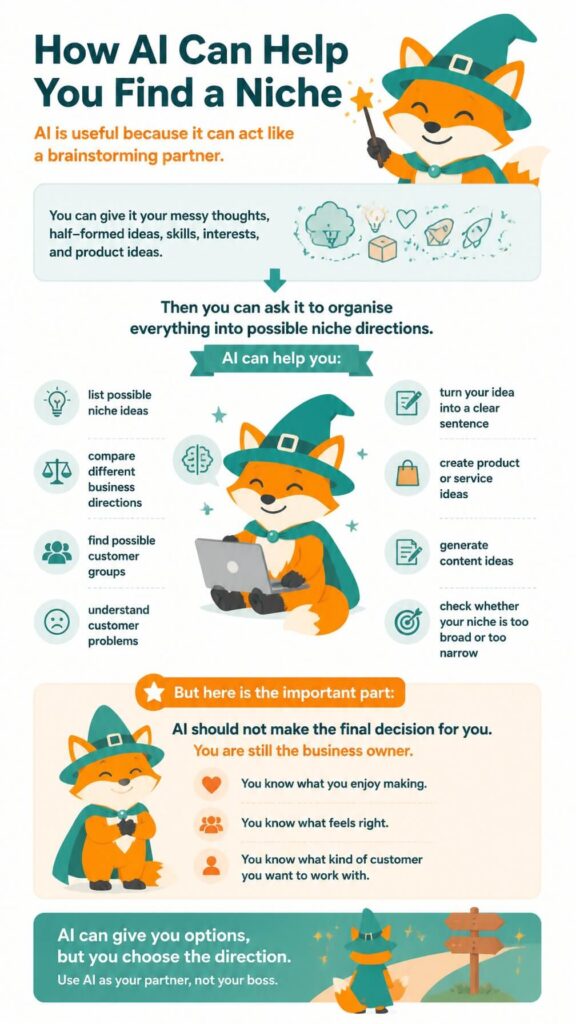
AI can help you:
- list possible niche ideas
- compare different business directions
- find possible customer groups
- understand customer problems
- turn your idea into a clear sentence
- create product or service ideas
- generate content ideas
- check whether your niche is too broad or too narrow
But here is the important part:
AI should not make the final decision for you.
You are still the business owner.
You know what you enjoy making.
You know what feels right.
You know what kind of customer you want to work with.
AI can give you options, but you choose the direction.
Step 1: Tell AI About Yourself
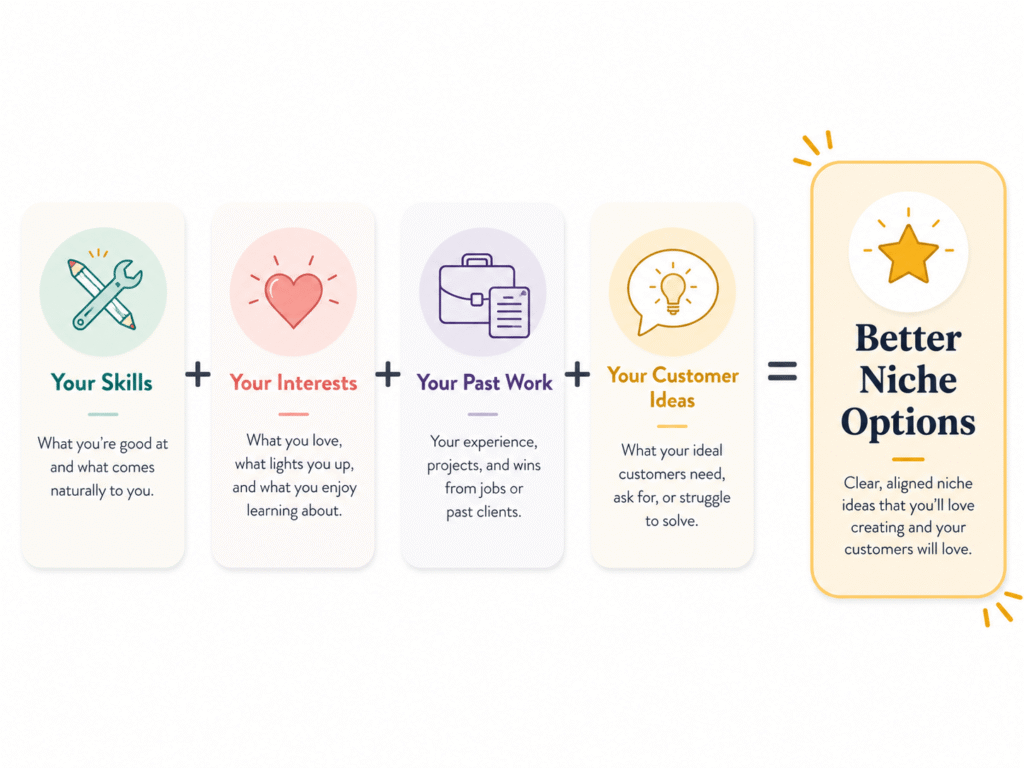
Before asking AI for niche ideas, you need to give it some information about you.
If you only ask:
“Give me a business niche.”
The answer will probably be too generic.
Instead, tell AI about your skills, interests, past work, and the kind of creative business you are thinking about.
Use this prompt:
I want to start or improve a small creative business. Here is what I enjoy: [write your interests] Here are my skills: [write your skills] Here are things I have made before: [write examples] Here are the types of customers I like helping: [write if you know] Here are my business ideas so far: [write your ideas] Please help me find possible niche ideas based on this. Keep the language simple and practical.
For example, you might write:
I want to start a small creative business. Here is what I enjoy: I enjoy making handmade candles, choosing soft colours, creating calming scents, and designing simple packaging. Here are my skills: Basic product photography, Canva design, packaging ideas, and social media posting. Here are things I have made before: Soy candles, small gift boxes, labels, and Instagram posts. Here are the types of customers I like helping: Women, mums, gift buyers, and people who like cosy home products. Here are my business ideas so far: Candles, gift boxes, self-care bundles, and personalised candle labels. Please help me find possible niche ideas based on this. Keep the language simple and practical.
This gives AI much better material to work with.
Instead of guessing, it can help you find ideas that match your real interests and skills.
Step 2: Ask AI for Niche Ideas
Once AI understands your background, ask it to generate possible niches.
Use this prompt:
Based on what I shared, give me 10 possible niche ideas for my creative business.
For each niche, include:
1. Who the customer is
2. What problem or desire they have
3. What I could sell
4. Why this niche could work
Keep everything beginner-friendly and realistic.
AI might give you ideas like:
| Niche Idea | Customer | What You Could Sell |
| Calming candles for busy mums | Mums who want quiet time | Soy candles, self-care gift boxes |
| Personalised candle gifts | Gift buyers | Custom labelled candles |
| Wedding favour candles | Brides and event planners | Small candle sets |
| Cosy home candles | Home decor lovers | Seasonal scent collections |
| Mindful desk candles | Work-from-home customers | Small candles for focus and calm |
At this stage, do not judge the ideas too quickly.
The goal is not to find the perfect niche immediately.
The goal is to see your options clearly.
Sometimes the best idea is not the first one.
Sometimes AI gives you an idea that feels almost right, and you can improve it.
Step 3: Look for the Ideas That Feel Natural
After AI gives you niche ideas, read through them slowly.
Ask yourself:
- Which idea feels exciting?
- Which idea feels easy to explain?
- Which customer do I understand best?
- Which product would I enjoy making again and again?
- Which idea feels realistic with my time, budget, and skills?
- Which idea could I create content about every week?
This part matters.
A niche is not only about what can make money.
It also needs to fit you.
If you choose a niche only because it sounds profitable, but you hate making the product or talking to that audience, you may lose motivation quickly.
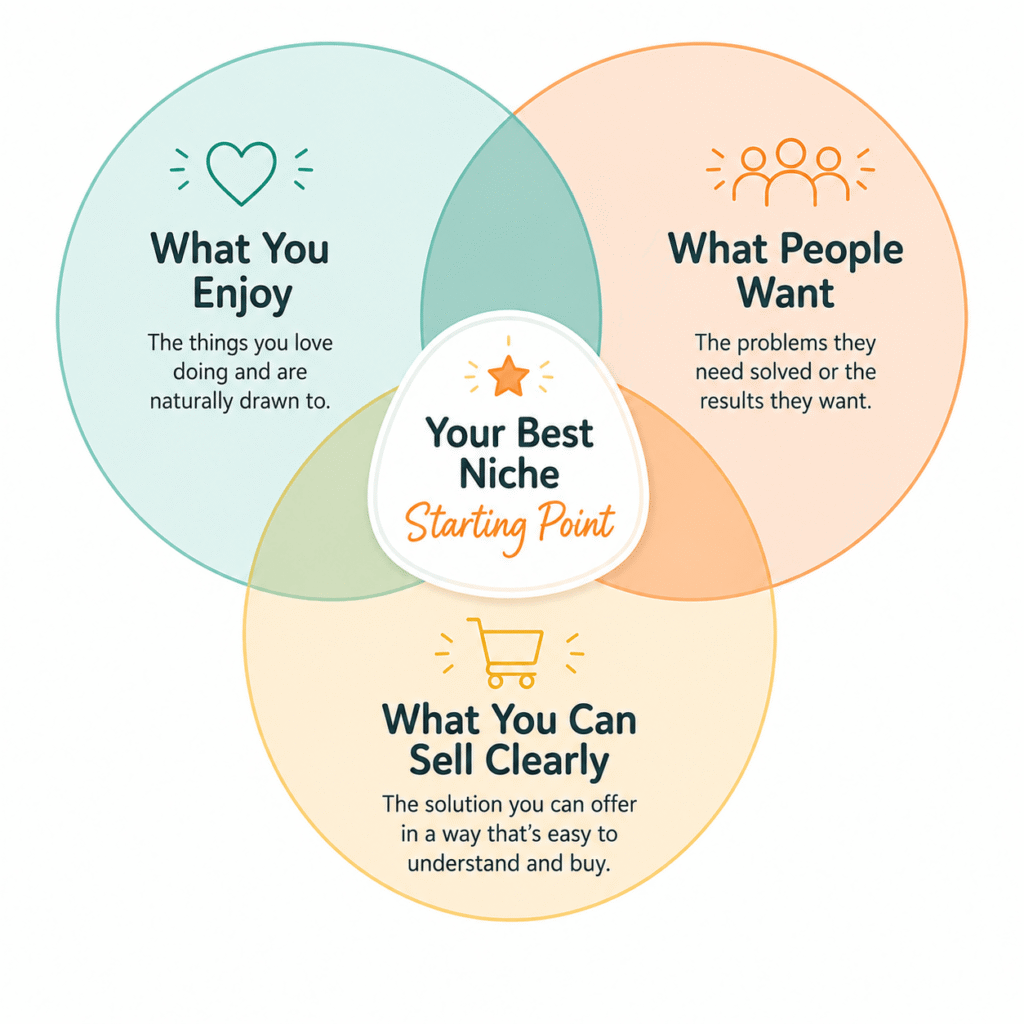
A good niche usually sits between three things:
- What you enjoy creating
- What people actually want
- What you can explain clearly
That middle area is where your business has a better chance to grow.
Step 4: Ask AI to Score Your Niche Ideas
Now you can ask AI to compare your niche ideas.
This helps you avoid choosing only based on emotion.
Use this prompt:
Here are my niche ideas: [paste your niche ideas] Please rate each idea from 1 to 5 for: 1. Customer demand 2. Ease of starting 3. Profit potential 4. Content potential 5. How clear the niche is Then tell me the top 3 strongest options and explain why in simple language.
AI may create a table like this:
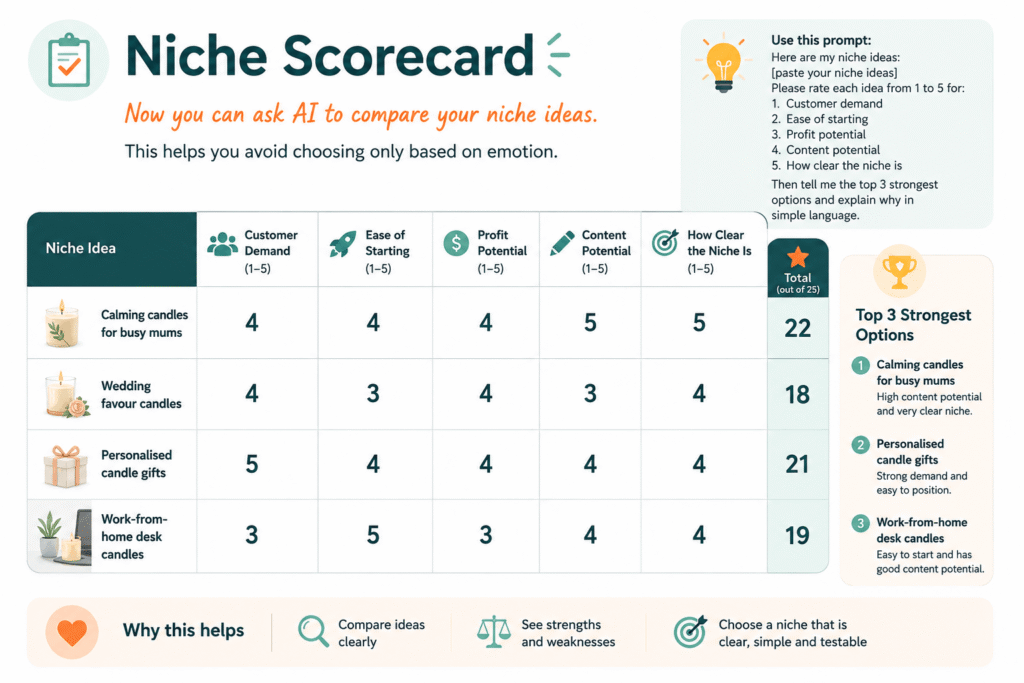
This kind of table is not perfect, but it is useful.
It helps you slow down and compare your options.
You may realise that one idea is fun but hard to explain.
Another idea may be simple, clear, and easier to test.
That is valuable.
Step 5: Understand the Customer Behind the Niche
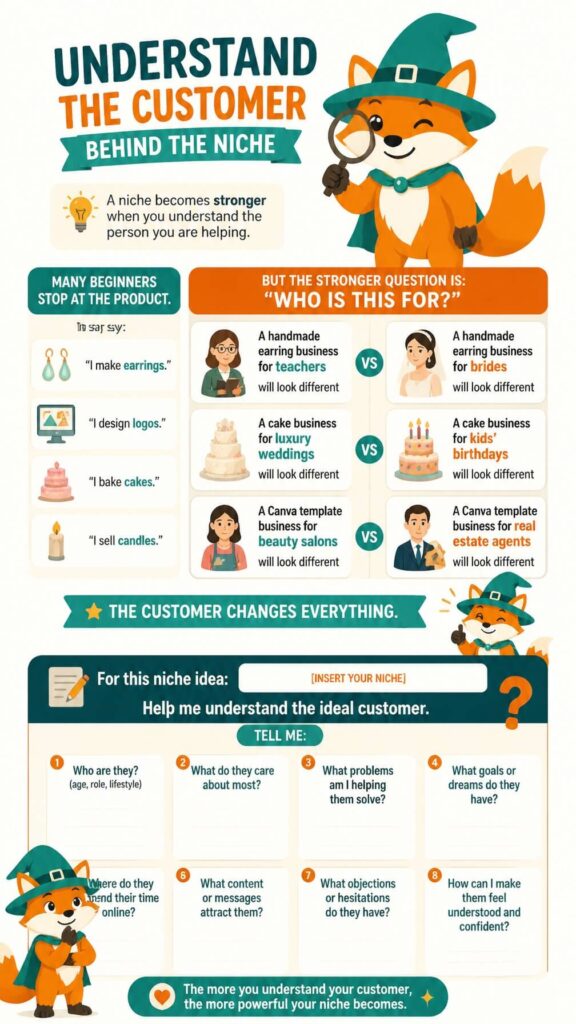
A niche becomes stronger when you understand the person you are helping.
Many beginners stop at the product.
They say:
“I make earrings.”
“I design logos.”
“I bake cakes.”
“I sell candles.”
But the stronger question is:
Who is this for?
A handmade earring business for teachers will look different from a handmade earring business for brides.
A cake business for luxury weddings will look different from a cake business for kids’ birthdays.
A Canva template business for beauty salons will look different from one for real estate agents.
The customer changes everything.
Use this prompt:
For this niche idea: [insert your niche] Help me understand the ideal customer. Tell me:
Example niche:
Custom birthday cake toppers for busy mums planning kids’ parties.
AI may tell you the customer is:
- A parent planning a child’s birthday party
- Busy and possibly organising everything last minute
- Looking for something cute, personal, and affordable
- Searching for party ideas, cake inspiration, and theme decorations
- Interested in before-and-after photos, party setup ideas, and simple ordering steps
- More likely to trust clear photos, reviews, prices, and delivery information
Now the niche feels more real.
You are no longer making random cake toppers.
You are helping a busy parent make a birthday feel special without adding more stress.
That is a much stronger business message.
Step 6: Find the Problems Your Audience Cares About
People do not always buy because they need a product.
They buy because they want a result, a feeling, or a solution.
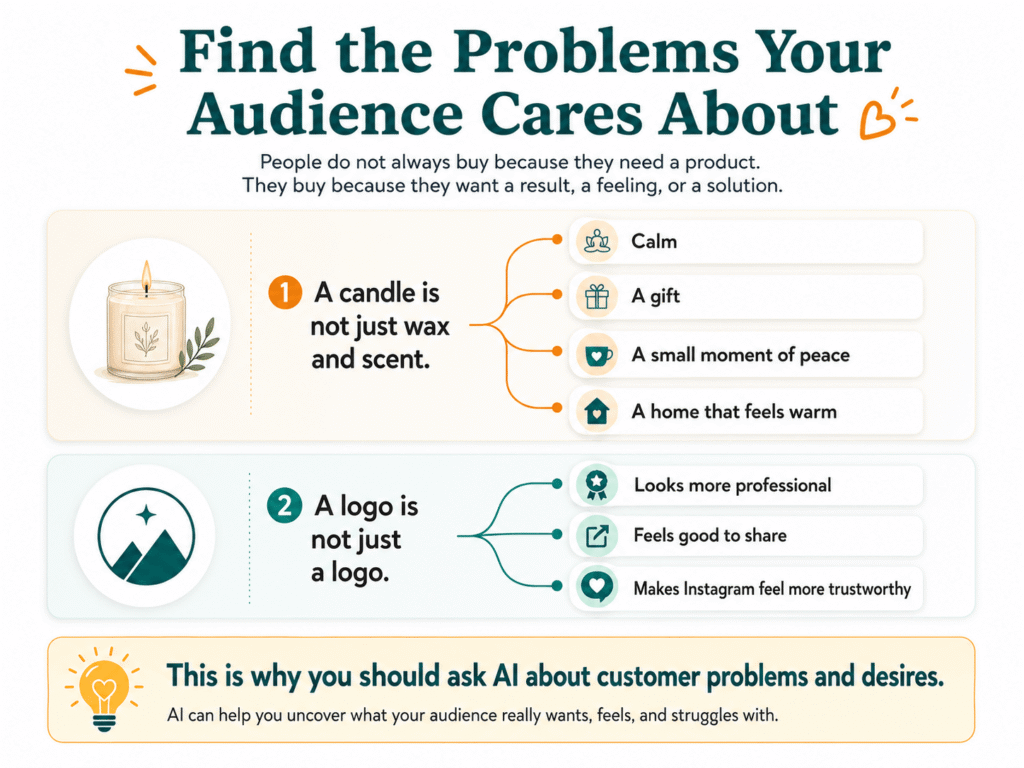
A candle is not just wax and scent.
It can be calm.
It can be a gift.
It can be a small moment of peace.
It can make a home feel warm.
A logo is not just a logo.
It can help a small business look professional.
It can help someone feel proud to share their brand.
It can make their Instagram page feel more trustworthy.
This is why you should ask AI about customer problems and desires.
Use this prompt:
For this audience: [describe your audience] What are 20 problems, frustrations, wishes, or emotional reasons they may have before buying this type of product or service? Write them in simple everyday language.
For a florist, AI might suggest:
- “I don’t know what flowers to choose.”
- “I need a gift that feels personal.”
- “I want something beautiful but not too expensive.”
- “I forgot an anniversary and need something quickly.”
- “I want flowers that look good in photos.”
- “I don’t want the arrangement to look cheap.”
- “I want to support a small local business.”
These problems can become your content ideas, product descriptions, captions, website copy, and offers.
This is one of the most useful parts of using AI for niche research.
You start seeing the business from the customer’s side.
Step 7: Turn Your Niche Into One Clear Sentence
Once you understand your product, audience, and customer problem, you can turn your niche into a simple sentence.
Use this formula:
I help [specific audience] with [specific problem or desire] by offering [creative product or service] in a [style or approach].
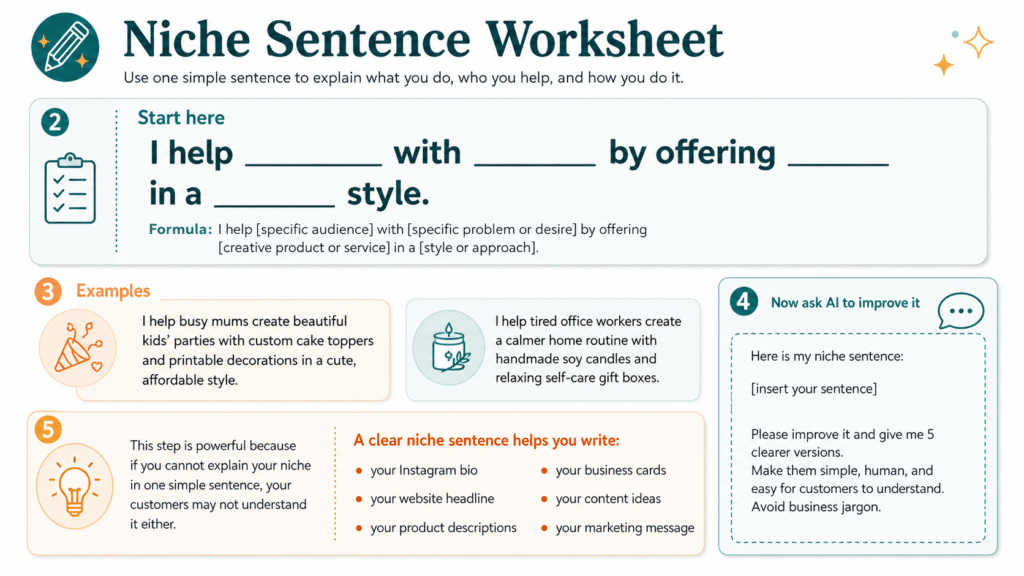
Here are a few examples:
I help busy mums create beautiful kids’ parties with custom cake toppers and printable decorations in a cute, affordable style.
I help handmade sellers look more professional online with simple Canva brand kits and social media templates.
I help brides create soft romantic wedding memories with custom floral illustrations and printed keepsakes.
I help tired office workers create a calmer home routine with handmade soy candles and relaxing self-care gift boxes.
Now ask AI to help you improve your sentence.
Use this prompt:
Here is my niche sentence: [insert your sentence] Please improve it and give me 5 clearer versions. Make them simple, human, and easy for customers to understand. Avoid business jargon.
This step is powerful because if you cannot explain your niche in one simple sentence, your customers may not understand it either.
A clear niche sentence helps you write:
- your Instagram bio
- your website headline
- your product descriptions
- your business cards
- your content ideas
- your marketing message
Step 8: Check If Your Niche Is Too Broad or Too Narrow
A beginner’s niche often has one of two problems.
It is either too broad or too narrow.
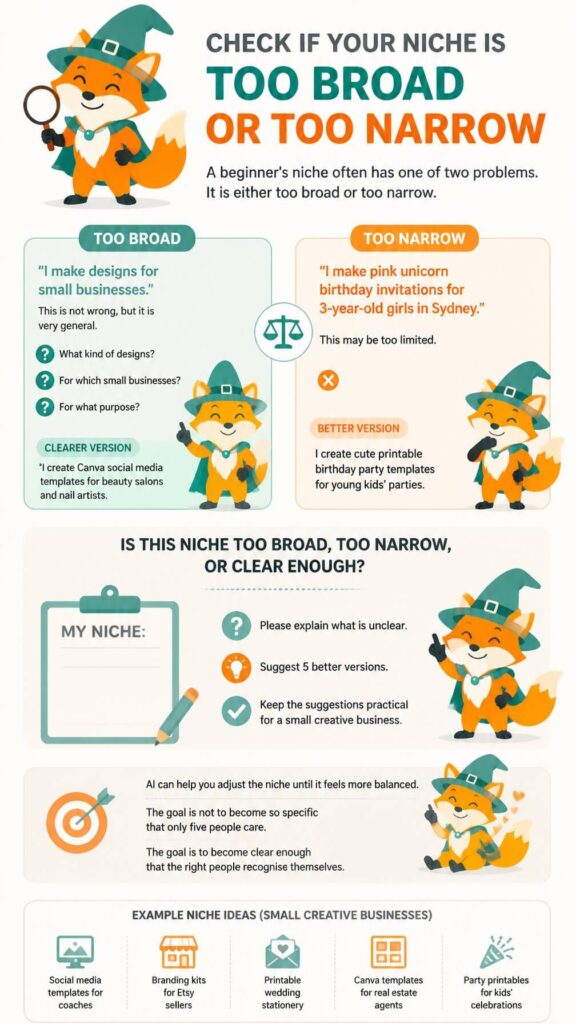
Too broad:
“I make designs for small businesses.”
This is not wrong, but it is very general.
What kind of designs?
For which small businesses?
For what purpose?
A clearer version:
“I create Canva social media templates for beauty salons and nail artists.”
Now it is easier to understand.
Too narrow:
“I make pink unicorn birthday invitations for 3-year-old girls in Sydney.”
This may be too limited.
A better version:
“I create cute printable birthday party templates for young kids’ parties.”
Still specific, but not too tiny.
Use this AI prompt:
Is this niche too broad, too narrow, or clear enough? My niche: [insert your niche] Please explain what is unclear and suggest 5 better versions. Make the suggestions practical for a small creative business.
AI can help you adjust the niche until it feels more balanced.
The goal is not to become so specific that only five people care.
The goal is to become clear enough that the right people recognise themselves.
Step 9: Ask AI for Product or Service Ideas
Once your niche is clearer, ask AI what you could actually sell.
Use this prompt:
For this niche: [insert your niche] Give me 10 simple product or service ideas I could sell. For each idea, include: 1. What it is 2. Who it is for 3. Why someone would buy it 4. Whether it is beginner-friendly to start
Example niche:
Canva templates for small beauty businesses.
AI might suggest:
| Product Idea | Who It Is For | Why They Would Buy |
| Instagram post templates | Nail artists and beauty salons | Saves time creating posts |
| Price list template | Service-based beauty businesses | Makes prices look professional |
| Instagram story highlight covers | Salons and lash techs | Improves profile branding |
| Promo flyer templates | Small beauty businesses | Helps advertise offers |
| Booking announcement templates | Home-based beauty services | Makes updates look polished |
This step helps you move from “nice idea” to “real offer.”
A niche is only useful if you can create something valuable for that audience.
Step 10: Ask AI for Content Ideas to Test the Niche
Before fully committing to a niche, test whether you can create content around it.
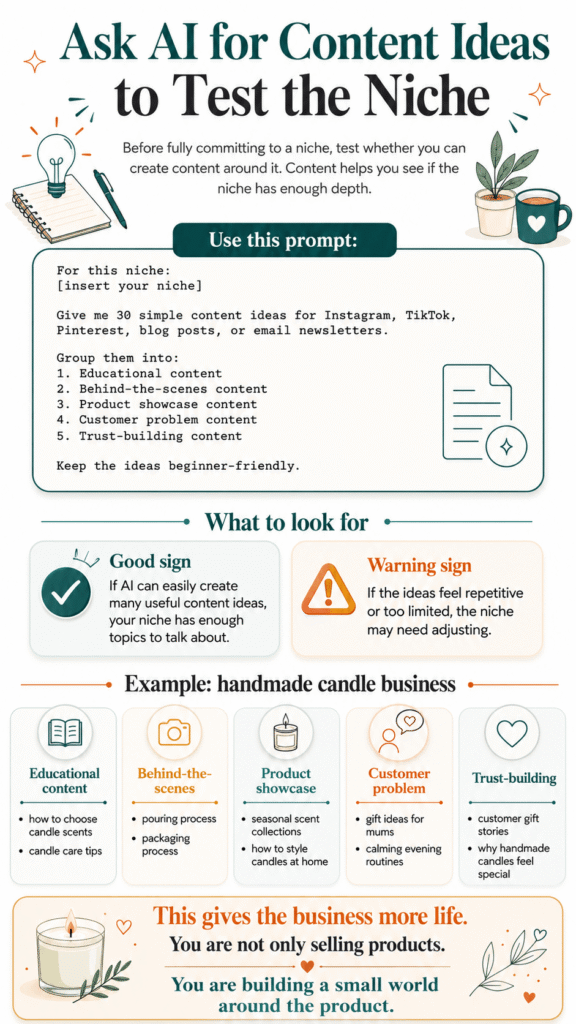
Content helps you see if the niche has enough depth.
Use this prompt:
For this niche: [insert your niche] Give me 30 simple content ideas for Instagram, TikTok, Pinterest, blog posts, or email newsletters. Group them into: 1. Educational content 2. Behind-the-scenes content 3. Product showcase content 4. Customer problem content 5. Trust-building content Keep the ideas beginner-friendly.
If AI can easily create many useful content ideas, that is a good sign.
It means your niche has enough topics to talk about.
If the ideas feel repetitive or too limited, the niche may need adjusting.
For example, a handmade candle business could create content about:
- how to choose candle scents
- gift ideas for mums
- behind-the-scenes pouring process
- how to style candles at home
- calming evening routines
- candle care tips
- packaging process
- customer gift stories
- seasonal scent collections
This gives the business more life.
You are not only selling products.
You are building a small world around the product.
Step 11: Do a Simple Reality Check
AI can give you ideas, but you still need to check reality.
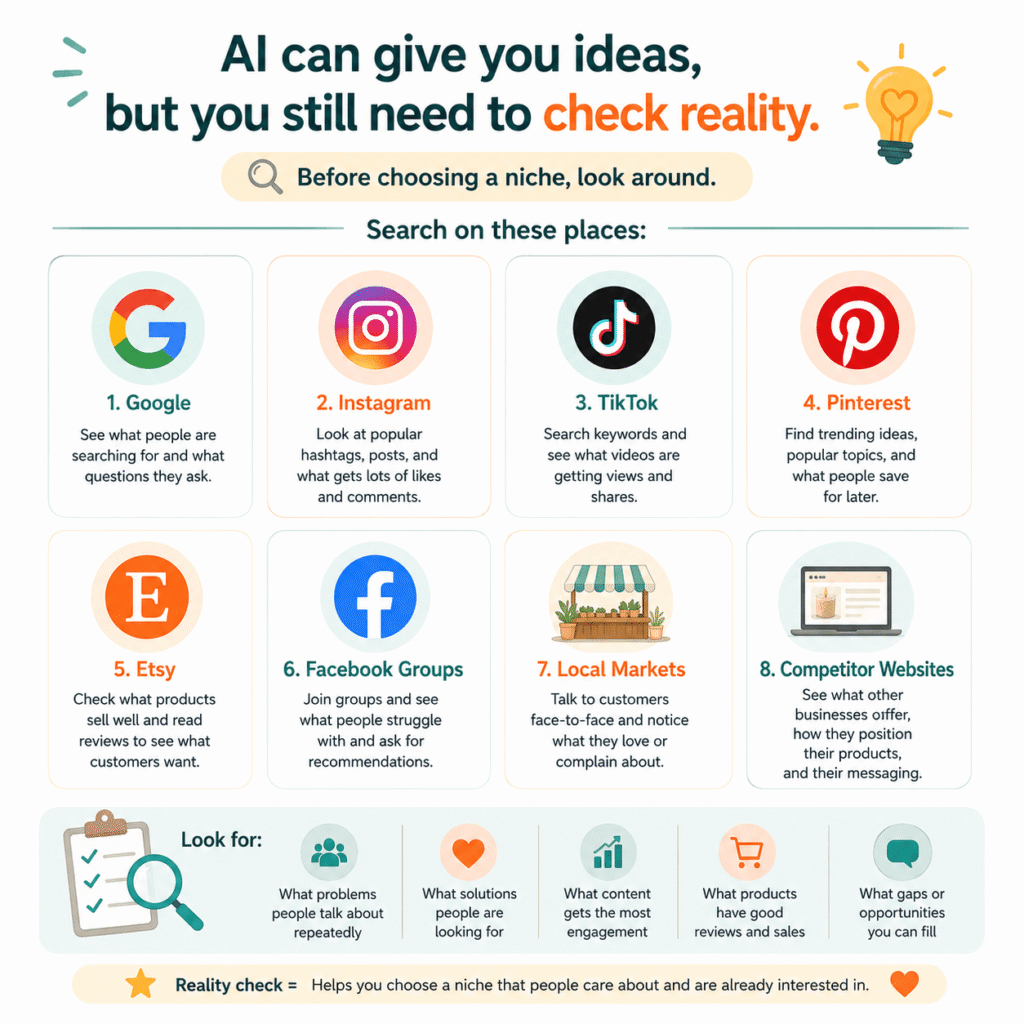
Before choosing a niche, look around.
Search on:
- TikTok
- Etsy
- Facebook groups
- local markets
- competitor websites
You are not copying.
You are checking if real people are already interested in this type of product or service.
Look for signs like:
- Are people buying similar products?
- Are people commenting on this topic?
- Are there active businesses in this space?
- Are there common customer questions?
- Are there gaps you could improve?
- Are people saving or sharing this type of content?
Competition is not always bad.
If other businesses exist, it may mean there is demand.
The goal is not to find an idea nobody has ever done.
The goal is to find your own angle inside a market people already understand.
For example:
Instead of: “Candles” Your angle could be: “Calming candle gift boxes for tired mums.”
Instead of: “Canva templates” Your angle could be: “Simple Canva templates for home-based beauty businesses.”
Instead of: “Cakes” Your angle could be: “Minimal birthday cakes for parents who want beautiful but simple party styling.”
That is how you start to stand out.
Step 12: Choose One Niche to Test
After brainstorming, scoring, checking the audience, and creating content ideas, choose one niche to test.
Do not overthink this part forever.
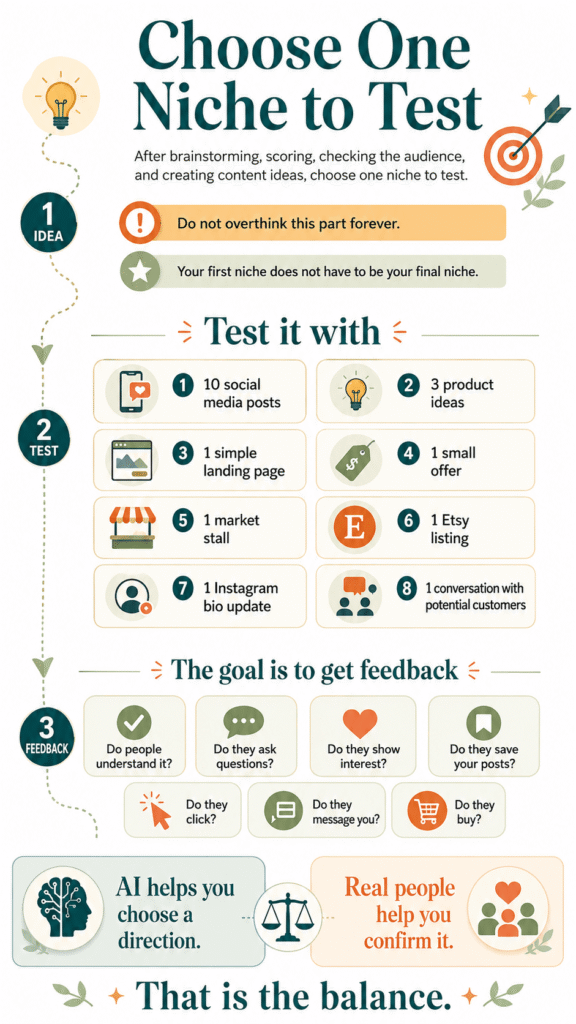
Your first niche does not have to be your final niche.
You can test it with:
- 10 social media posts
- 3 product ideas
- 1 simple landing page
- 1 small offer
- 1 market stall
- 1 Etsy listing
- 1 Instagram bio update
- 1 conversation with potential customers
The goal is to get feedback.
Do people understand it?
Do they ask questions?
Do they show interest?
Do they save your posts?
Do they click?
Do they message you?
Do they buy?
AI helps you choose a direction.
Real people help you confirm it.
That is the balance.
A Full Example: From Messy Idea to Clear Niche
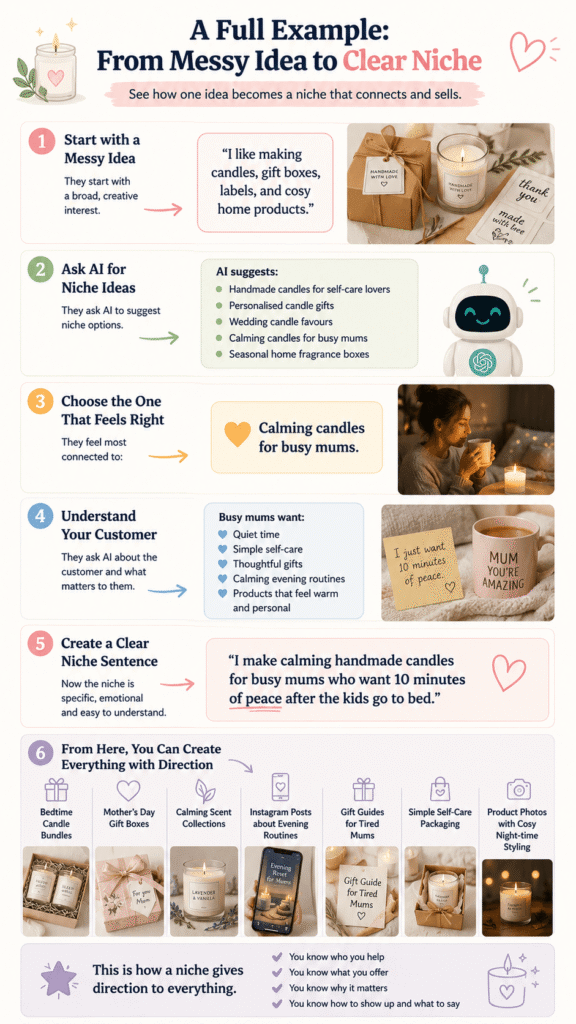
Let’s say someone starts with this:
“I like making candles, gift boxes, labels, and cosy home products.”
That is a nice creative area, but it is still broad.
They ask AI for niche ideas.
AI suggests:
- Handmade candles for self-care lovers
- Personalised candle gifts
- Wedding candle favours
- Calming candles for busy mums
- Seasonal home fragrance boxes
The person feels most connected to:
Calming candles for busy mums.
Then they ask AI about the customer.
AI explains that busy mums may want:
- quiet time
- simple self-care
- thoughtful gifts
- calming evening routines
- products that feel warm and personal
Now the niche becomes clearer:
“I make calming handmade candles for busy mums who want 10 minutes of peace after the kids go to bed.”
That is much stronger than:
“I sell candles.”
It has emotion.
It has a customer.
It has a situation.
It has a reason to buy.
From there, the business owner can create:
- bedtime candle bundles
- Mother’s Day gift boxes
- calming scent collections
- Instagram posts about evening routines
- gift guides for tired mums
- simple self-care packaging
- product photos with cosy night-time styling
This is how a niche gives direction to everything.
Useful AI Prompts You Can Copy
Here are the main prompts from this guide in one place.
Prompt 1: Find niche ideas
I want to start or improve a small creative business. Here is what I enjoy: [write your interests] Here are my skills: [write your skills] Here are things I have made before: [write examples] Here are the types of customers I like helping: [write if you know] Here are my business ideas so far: [write your ideas] Please help me find possible niche ideas based on this. Keep the language simple and practical.
Prompt 2: Generate 10 niche options
Based on what I shared, give me 10 possible niche ideas for my creative business. For each niche, include: 1. Who the customer is 2. What problem or desire they have 3. What I could sell 4. Why this niche could work Keep everything beginner-friendly and realistic.
Prompt 3: Score niche ideas
Here are my niche ideas: [paste your niche ideas] Please rate each idea from 1 to 5 for: 1. Customer demand 2. Ease of starting 3. Profit potential 4. Content potential 5. How clear the niche is Then tell me the top 3 strongest options and explain why in simple language.
Prompt 4: Understand the customer
For this niche idea: [insert your niche] Help me understand the ideal customer. Tell me: 1. Who they are 2. What they care about 3. What problems they have 4. What they may search online 5. What kind of content they would enjoy 6. What would make them trust my business Use simple language.
Prompt 5: Find customer problems
For this audience: [describe your audience] What are 20 problems, frustrations, wishes, or emotional reasons they may have before buying this type of product or service? Write them in simple everyday language.
Prompt 6: Improve your niche sentence
Here is my niche sentence: [insert your sentence] Please improve it and give me 5 clearer versions. Make them simple, human, and easy for customers to understand. Avoid business jargon.
Prompt 7: Check if your niche is clear
Is this niche too broad, too narrow, or clear enough? My niche: [insert your niche] Please explain what is unclear and suggest 5 better versions. Make the suggestions practical for a small creative business.
Prompt 8: Create product or service ideas
For this niche: [insert your niche] Give me 10 simple product or service ideas I could sell. For each idea, include: 1. What it is 2. Who it is for 3. Why someone would buy it 4. Whether it is beginner-friendly to start
Prompt 9: Create content ideas
For this niche: [insert your niche] Give me 30 simple content ideas for Instagram, TikTok, Pinterest, blog posts, or email newsletters. Group them into: 1. Educational content 2. Behind-the-scenes content 3. Product showcase content 4. Customer problem content 5. Trust-building content Keep the ideas beginner-friendly.
Common Mistakes to Avoid
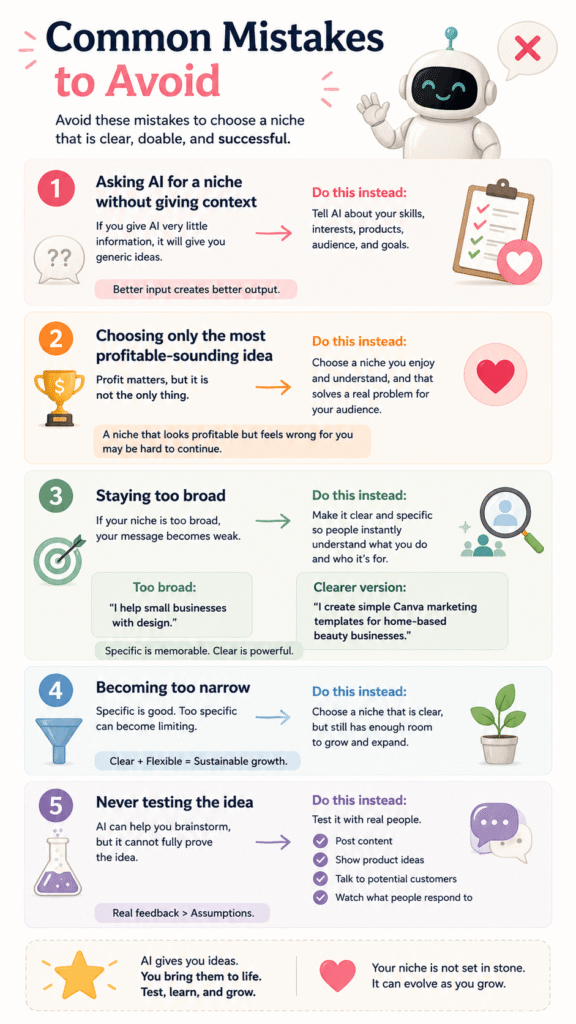
Mistake 1: Asking AI for a niche without giving context
If you give AI very little information, it will give you generic ideas.
Better input creates better output.
Tell AI about your skills, interests, products, audience, and goals.
Mistake 2: Choosing only the most profitable-sounding idea
Profit matters, but it is not the only thing.
You also need to enjoy the work and understand the customer.
A niche that looks profitable but feels wrong for you may be hard to continue.
Mistake 3: Staying too broad
If your niche is too broad, your message becomes weak.
For example:
“I help small businesses with design.”
This could mean anything.
A clearer version:
“I create simple Canva marketing templates for home-based beauty businesses.”
That is easier to remember.
Mistake 4: Becoming too narrow
Specific is good.
Too specific can become limiting.
You want a niche that is clear, but still has enough room to grow.
Mistake 5: Never testing the idea
AI can help you brainstorm, but it cannot fully prove the idea.
You still need to test it with real people.
Post content.
Show product ideas.
Talk to potential customers.
Watch what people respond to.
Final Thoughts
AI will not magically hand you the perfect niche.
But it can help you slow down, organise your thoughts, and see patterns you may have missed.
The best niche is usually not the fanciest idea.
It is the idea that sits between what you enjoy making, what people actually want, and what you can explain clearly.
Start there.
Use AI as your brainstorming partner.
Choose one direction.
Test it with real people.
Then improve as you learn.
Your niche does not have to be perfect from day one.
It only needs to be clear enough to start.